
Welcome to Agentic Web News: signals, interviews and analysis on the next phase of the web
Tracking how the agentic web is taking shape — through market signals, builder interviews, and analysis of the products and standards defining what's next.

This publication is a relaunch and a narrowing of focus. I began this site last August as Web Technology News, covering the broader web tech landscape — including the growing intersection of AI and the web. But over the past several months, I’ve found myself drawn to one theme above all others: AI agents are reshaping the web. That shift now deserves its own beat.
In a previous life, I chronicled the read/write web — a.k.a. Web 2.0. Agentic Web News (AWN) will do the same for the AI era of the internet — a.k.a. the agentic web. Btw I did buy the domain ReadWriteAgentic.com, but I thought it'd be a bit cheeky to use that. In any case, I think AgenticWeb.news is a neat domain!
If you decide to subscribe, what will you get? Well, my plan is to post a weekly analysis of the emerging market signals for the agentic web, along with regular interviews with the people and companies building out this new vision.
My challenge, as it is for any publisher right now, is to produce content that can't be replicated by an AI system. For the interviews, that's easy — because it'll be new, original content that comes from two human beings talking to each other. For the weekly market signals, my goal is to put as much of my own voice and personal experience into that as possible. It can't just be a list of things ChatGPT or Claude can produce for you every week.
In terms of format, I am thinking of AWN as a tech blog / email newsletter. Of course, the cold reality is that a blog — as a type of website — doesn't have a revenue model in 2026 (thanks, AI!). We're very far away from the online advertising boon of Web 2.0, which allowed my ReadWriteWeb blog to flourish and grow in that era. In this era, the only viable path to monetization is through subscription revenue — and perhaps some sponsors once I've gained traction.
So my plan is to eventually make everything but the interviews premium content. For now, everything is free. But if you would like to support me in this interim period, you can purchase an annual subscription for $100 or a monthly subscription for $10. Getting a new media product off the ground in this climate is incredibly difficult. So if you can afford it, or if you work in a company where you can expense this, I would very much appreciate your early support.
Let's get on with it. Here's what I've been seeing in the nascent agentic web over the past week...
Market Signals
📡 SEO/GEO/AEO conversations ⬆️
I've noticed that LinkedIn's collection of SEO influencers have started paying attention to optimization for AI search and chatbots. Most of that discussion has focused on Discovery (with a capital D), because that's what SEO has traditionally been about. My own focus has been on agent usability, i.e. how agents will use websites and apps going forward. I believe that is the key, especially once nascent protocols like WebMCP and Agent2Agent (A2A) gain traction.
Over the past week, the SEO influencers have gotten even more excited after Google updated some of its guidance documentation. The one that stood out to me was Google's advice on how to explore agentic experiences. This noted that browser agents might take actions such as "analyzing visual renderings (like screenshots), inspecting the DOM structure, and interpreting the accessibility tree." Google pointed to further advice on building agent-friendly websites, which emphasizes semantic HTML and accessibility principles.
The main takeaways here are: a) Google is saying GEO/AEO (Generative experience optimization / Answer engine optimization) is basically the same as SEO in terms of its advice for publishers, and b) agents are being recognized as valid users of the web that need to be designed for.
Related: DebugBear noted that Google's Lighthouse audit tool has a new "agentic browsing" section, currently marked as "under development."
📡 Apps are becoming more agentic 🚀
Vercel released a report this week that I thought gives a very boomish signal about agentic applications — or, put another way, apps that aren't simply chatbots in a trenchcoat, but apps that do jobs and tasks for the user. This goes back to a core thesis of my Agentic Web Playbook: capabilities matter as much as content now.
According to Vercel, which is one of the main developer platforms for AI-fueled applications, production AI requests are increasingly for tool calls:
"In April 2026, 22.2% of AI Gateway requests ended with a tool call, up from 11.4% in October 2025. Measured by tokens, the shift is bigger. 58.9% of all tokens are now in tool-call requests, up from 31.6% six months ago."
This is also another reminder that developers are paying more and more in API bills to the leading LLM providers, like Anthropic, OpenAI and Google. Not sure that's a great signal for the open web, which traditionally has relied on largely free, open source infrastructure (ref the LAMP stack). And it’s not just us users nervously checking our bank accounts, as this tweet from Vercel Chief of Software Andrew Qu shows:
me when my manager asks me how I spent $42,580 on tokens in a month pic.twitter.com/5AkAEac0w1
— Andrew Qu (@andrewqu) May 19, 2026
📡 Agentic commerce ⬆️
One of the areas of most activity so far at the intersection of AI and the web is "agentic commerce." There have been a number of new protocols in this space, including Agentic Commerce Protocol (ACP), an open standard being codeveloped by Stripe and OpenAI, and Universal Commerce Protocol (UCP) from Google, Shopify, and others.
But when it comes down to it, what matters is what's actually being implemented. This week Stripe CEO John Collison went on a Bloomberg podcast to explain how his payments company is adapting.
Collison said that Stripe is currently preparing its infrastructure for agentic commerce — including secure payment credentials, agent-compatible checkout, and ways to distinguish desirable agents from malicious bots. Collison also pointed out that interfaces are changing: "You need a textual interface for a bunch of things that previously might have been clicking around on a website."
With Amazon also making moves to integrate AI into its shopping experience, I expect rapid progress in agentic commerce this year.
Watchlist
As I track startups and protocols for the agentic web, I'll highlight ones that catch my eye. Here's one that, ironically perhaps, has a super-slick website for human users to browse through...
👀 Company to watch: Parallel Web Systems
There's a bunch of extremely well-funded agentic web infrastructure companies emerging, and Parallel is among them. It's building "a programmatic web for AIs" — such as search and research APIs for AI agents.
Parallel's homepage proclaims that "AIs are the web's new user" and its messaging is heavy on open web advocacy. For instance, this on its about page:
"The choice is binary: we build the open web for its second user, or it fractures beyond repair. At Parallel, we are building for abundance."
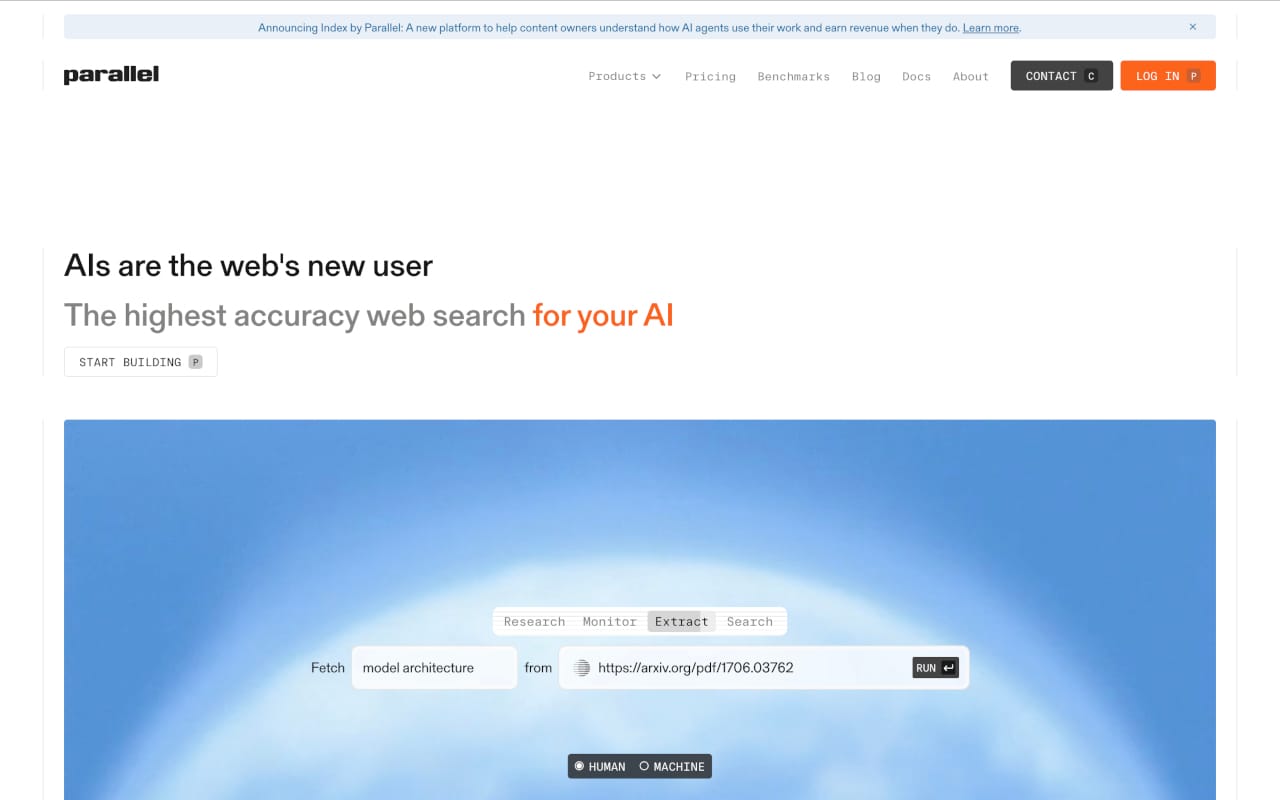
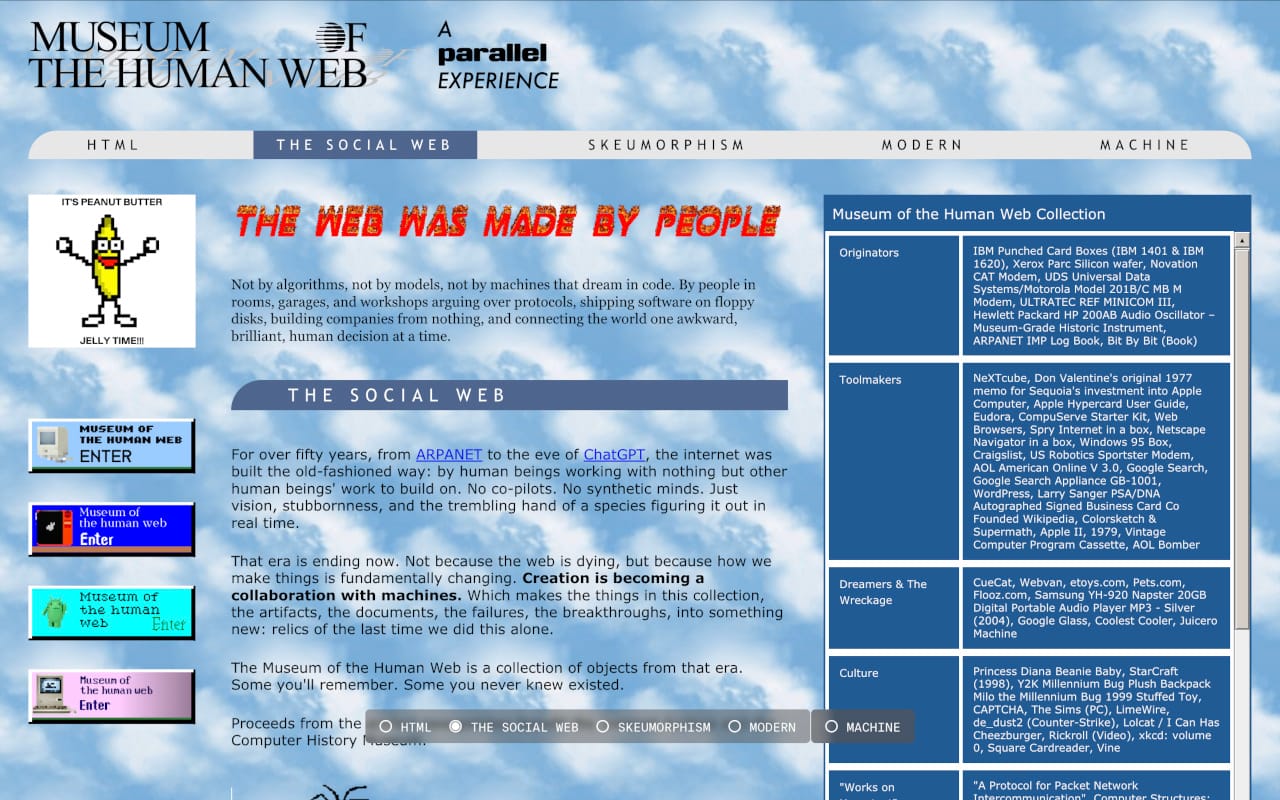
In addition to its fancy website, Parallel has been running an exhibition in San Francisco called The Museum of the Human Web. Again, I find the messaging to be quite intriguing (if also a little unsettling, as everything is about AI right now). The introduction to the museum site begins: "The web was made by people." That's obviously what the museum is celebrating, but then comes this:
"That era [the human web] is ending now. Not because the web is dying, but because how we make things is fundamentally changing. Creation is becoming a collaboration with machines."
Some would argue the web should remain solely human-made — I'm thinking here of my fellow open social web fans on Mastodon and Bluesky. But I have to say I'm a pragmatist about this: the agentic web is here already, so we humans have to adapt. More than that: I think we can harness (to use a trendy term) agentic tools to keep the web open and ensure that it continues to serve humanity. I'll write more about that in a future post.
Btw Parallel's founding CEO is none other than Parag Agrawal, who led Twitter before Elon Musk acquired it (and promptly sacked him). We'll see if Parallel does indeed become a major agentic web infrastructure company; it's certainly done a good job with early positioning.
Thanks for reading Agentic Web News — my independent analysis of the companies, standards and ideas shaping the next phase of the web. Alongside weekly market signals, I’ll be publishing interviews with the early builders defining this space.
If this issue helped clarify where the agentic web is heading, please forward it to someone who should be tracking this trend.
To receive future editions, subscribe by email. It's currently free, but you can also become a founding supporter of AWN, to help it become financially viable.
I also advise companies on agentic web strategy, Agent Experience, AI visibility, and agent-facing product strategy. Learn more at ricmac.org.

Comments ()