
Nekuda's WebMCP bet: Agentic commerce still needs the website
Nekuda is betting that agentic commerce will augment websites, not replace them, with WebMCP providing the bridge between agents and merchant-controlled experiences.
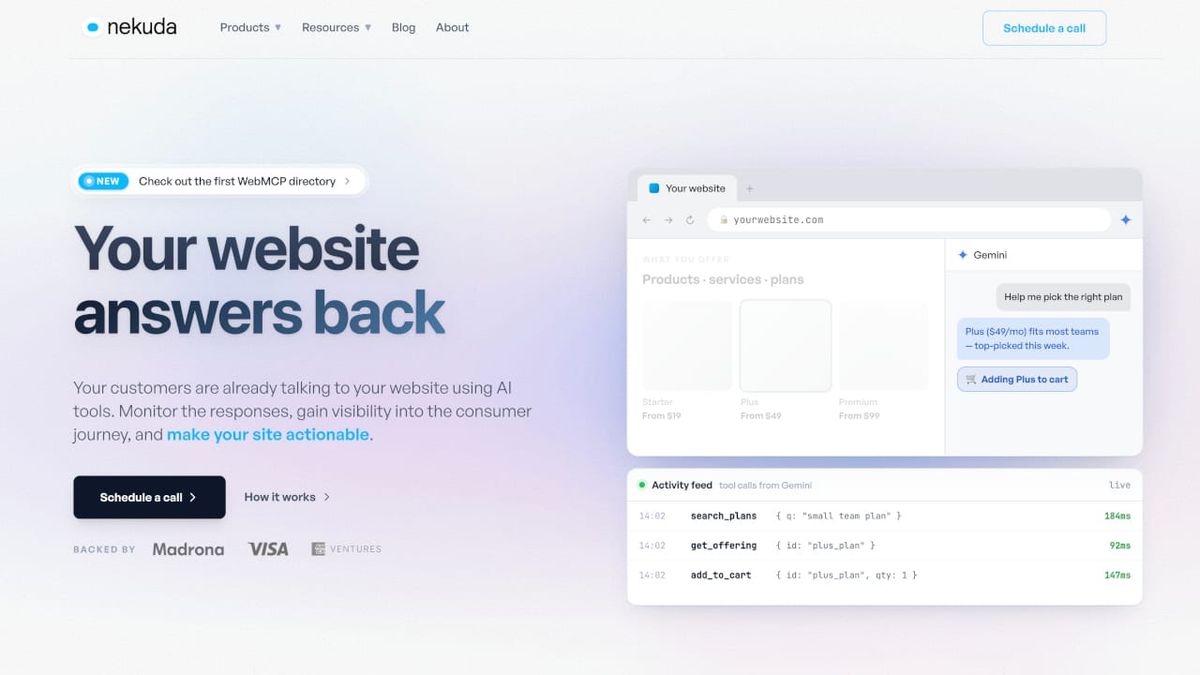
Nekuda is an agentic commerce startup with a refreshing difference: it is betting on websites continuing to flourish, rather than AI chatbots completely taking over the shopping experience. I spoke with founding CEO Ayal Karmi about why the emerging WebMCP open standard underpins its web-based strategy.
Before we begin, it's useful to frame the current thinking about the role of a user interface in the agentic web. The following graphic from Nekuda shows the spectrum from headless, to "near-headless," to what the company calls the "co-assisted web."
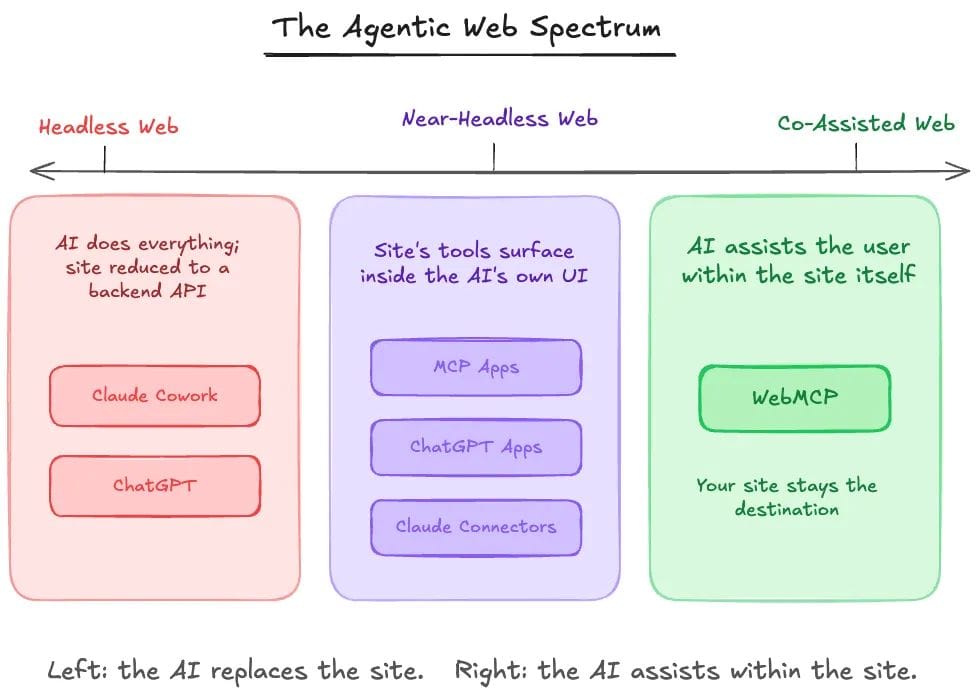
As the term suggests, the "headless web" doesn't require a UI. But the near-headless web does; and in many cases, web technology is used to render that interface — even though it's inside an AI chatbot or agent.
As for Nekuda, it's very much in the "co-assisted" segment of this graphic. Karmi told me that he sees AI systems as key to the discovery of products, but that the shopping experience will continue to rely on websites.
"The transaction, the checkout and the questions that lead to a purchase are still going to happen on the website," he said.
The Failed Pizza Experiment
Nekuda didn't immediately come to the conclusion that websites are still needed. The startup's initial idea was headless — it wanted to build wallet infrastructure for autonomous shopping agents. That idea was born about two years ago, after the founders created an agent and tried to order a pizza autonomously (mimicking the famous Bitcoin story of an early user paying for a pizza with cryptocurrency).
"The agent failed completely," explained Karmi. "The [pizza] website kind of killed us — the bot detection, the fraud detection, we tried to pay. It was kind of a headless bot that tried to order a pizza, scraping the menu and then tried to order it."
After that trial, Nekuda built a wallet for browser agents, which they thought would solve the automated payment problem. But it ended up teaching them a different lesson.
"The bigger issue here is that website owners basically told us they're afraid of being obfuscated," he said. "And also [...] they want a richer experience. Like, the web is there for a reason. And the website user experience is very important."
This is what eventually led Nekuda to WebMCP and a more website-centred vision of agentic commerce.
Why Nekuda turned to WebMCP
WebMCP is an emerging web API and proposed standard that allows websites and web applications to expose structured tools to browser-based agents. It's much more efficient than an agent scraping and trying to automatically traverse a human web interface. As I've noted previously, Google is in the process of baking WebMCP into its Chrome browser (it's currently in an origin trial). If the experiment succeeds and other browsers adopt it, WebMCP could become a standard way for websites to expose interactive capabilities to agents.
While it waits for full browser support for WebMCP, Nekuda has released an interim Chrome extension to demonstrate what a WebMCP-capable agent can do. Called Ask Nekuda, when installed it pops up a sidebar for any website that has WebMCP functionality. For example, when I visit my personal website, an Ask Nekuda popup displays — when clicked, it opens a sidebar exposing the two WebMCP actions I have implemented.
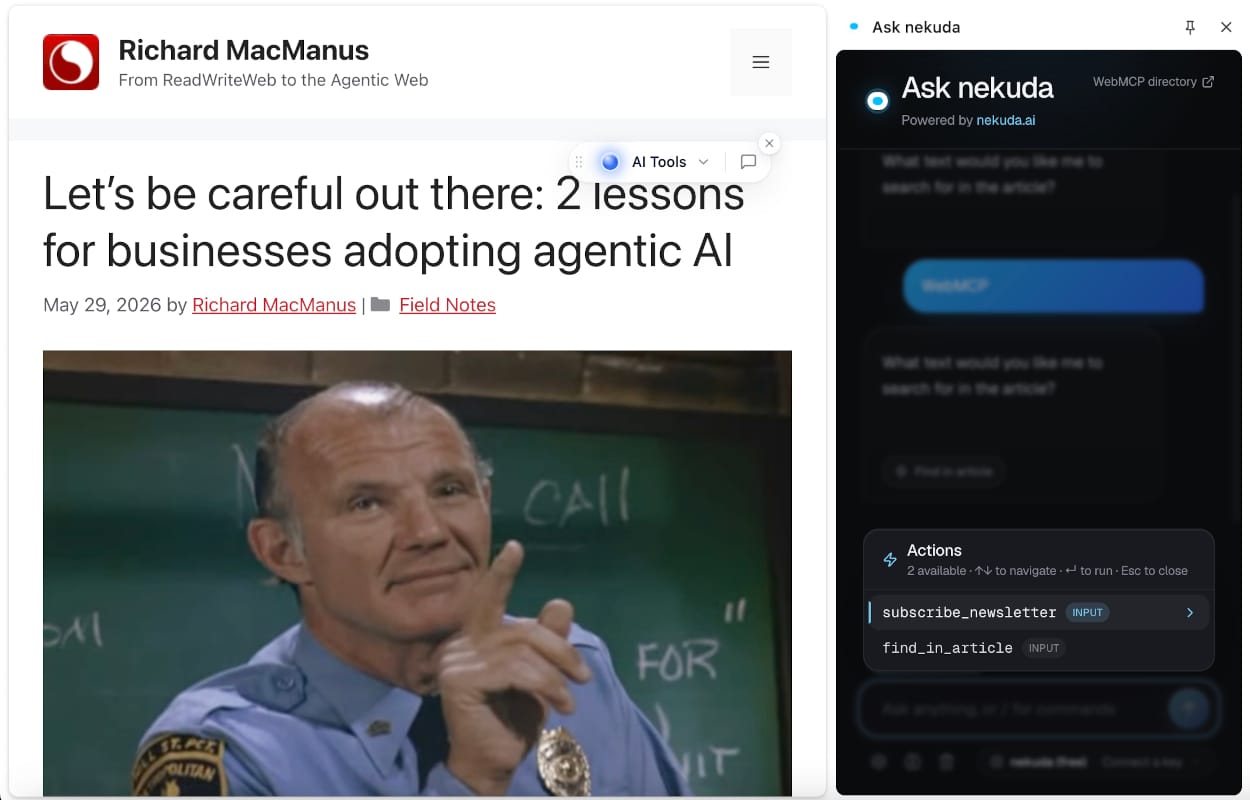
"We built the extension to inspire people, because there aren’t many examples of agents that can use WebMCP," Karmi explained. "It is more of a precursor to what we are doing: helping websites manage endpoints so agents can use the website, not just scrape it."
AgentLane
Nekuda's core product is called AgentLane. Karmi described it as a system for managing the tools and services a website exposes through WebMCP. The product is designed to help website operators add, modify and monitor WebMCP endpoints.
On the website, AgentLane is described more broadly as "Universal Checkout Infrastructure" that will work across different AI surfaces, using OpenAI's ACP and/or Google's UCP (both are open standards that enable AI agents to transact).
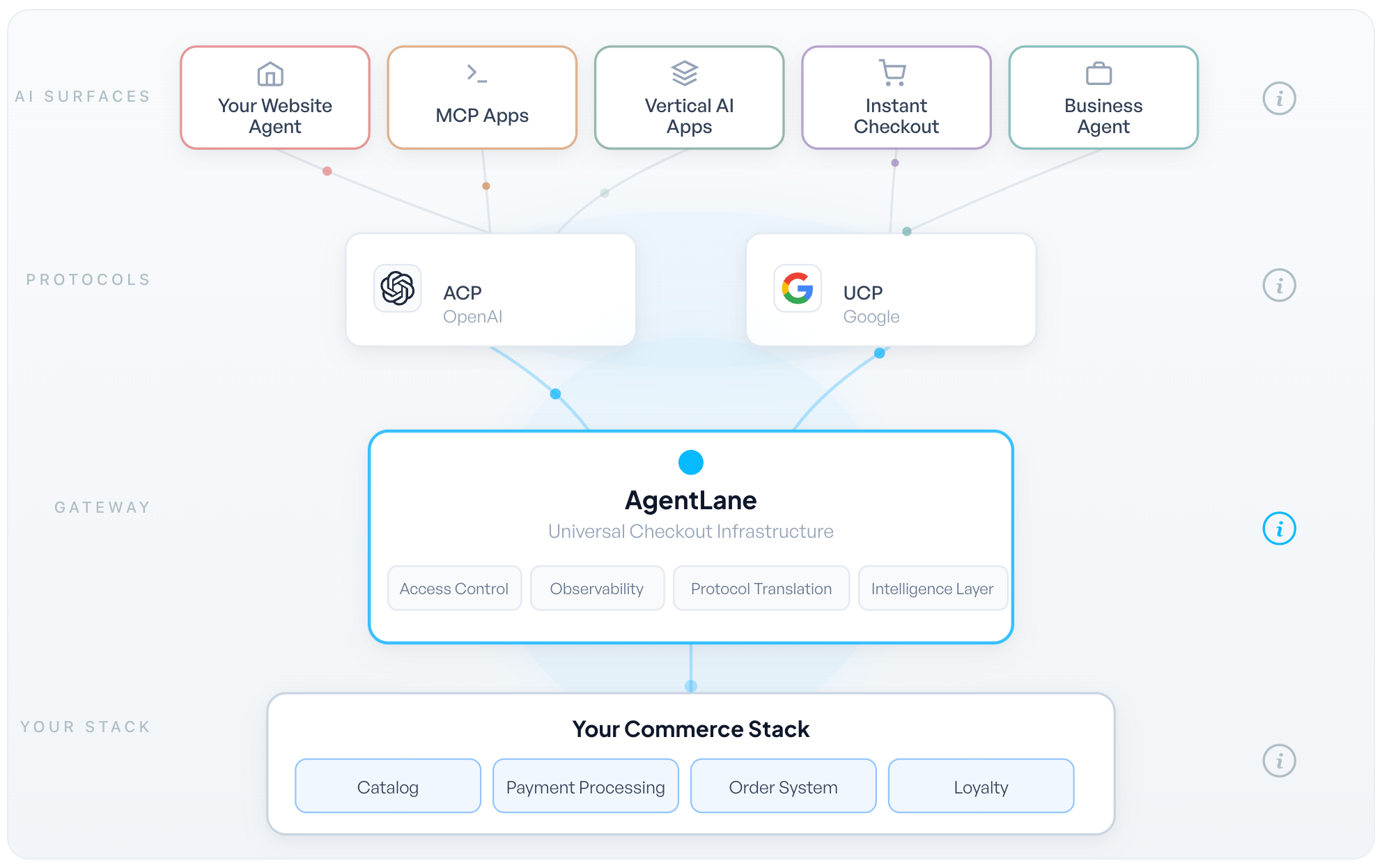
One of the things AgentLane will do is provide visibility into what actions agents are taking on your website, which Karmi notes is very difficult to achieve currently.
"It's not being discussed a lot today, but when users use an agent like Gemini in Chrome, the website owner has no idea," he said. "It's like a ghost right now that lives on your website. So by using these endpoints, using WebMCP, it [AgentLane] will allow you to see the agent journey, [...] see what the agent calls as tools or parameters."
AgentLane is currently in a private alpha and Karmi expects it to be released by summer.
Building around the WebMCP ecosystem
Alongside the extension, Nekuda has a few supporting products on its site — including an "agentic wallet," which was the company's original product inspired by the pizza experiment.
But Karmi was candid that demand for fully autonomous purchasing has not yet emerged at scale. Nekuda found that most consumers still want to be present for the consequential part of a transaction, while merchants do not want to disappear behind an agent-controlled interface.
"People want to be present and they want to use delightful user experiences, and they want the web," Karmi said.
Nekuda has a few useful ecosystem resources too, including a WebMCP directory showing sites that have already deployed the protocol.
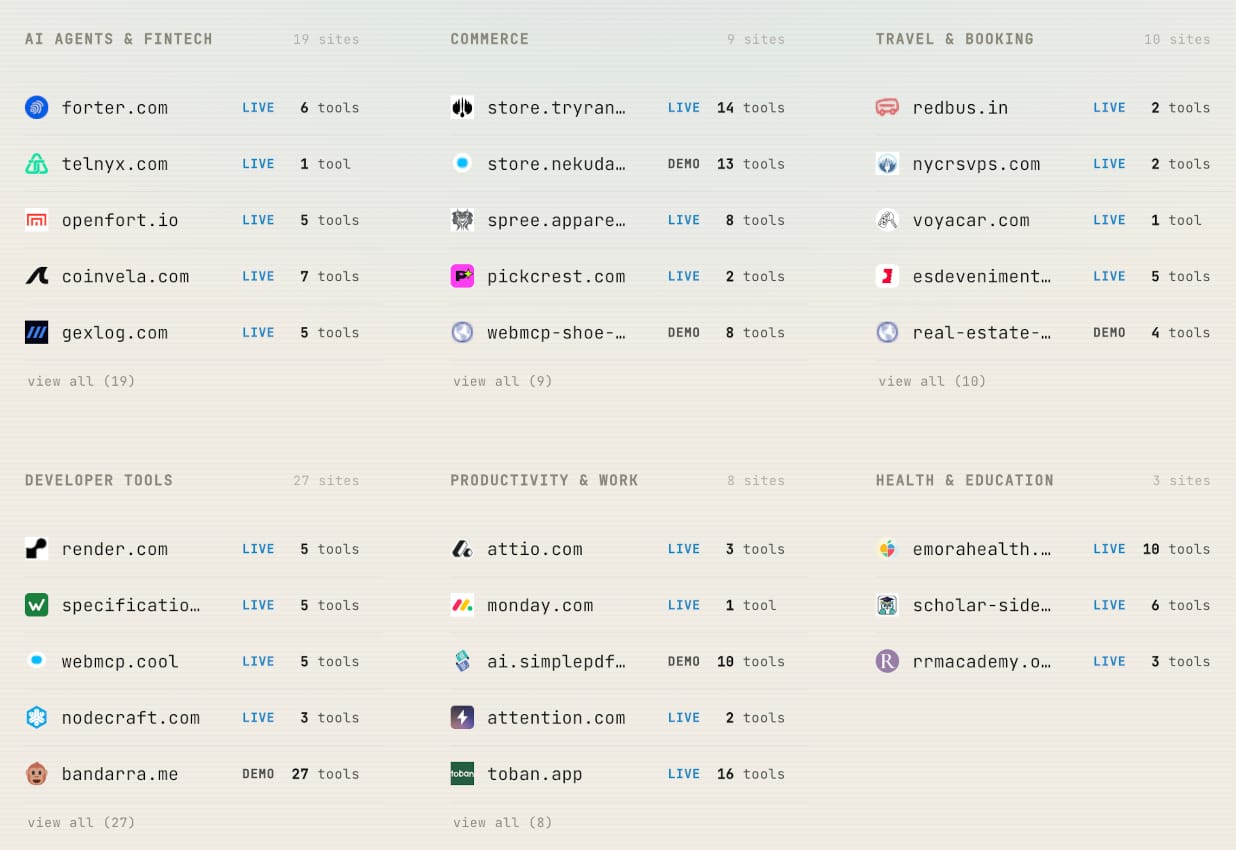
A website-centred agentic commerce model
What I like about Nekuda's vision is that it goes beyond merely helping merchants get discovered by AI systems, which is the focus of most "ASO" (agentic search optimization) discussions currently. Nekuda aims to help e-commerce vendors manage the entire purchasing flow, using their own websites to attract users — along with their agents — and encourage them to take actions.
While Nekuda's technology is still under development, I would expect the typical user / agent flow for a merchant website to be something like this:
- An AI assistant helps the user discover a business or product.
- The user opens the merchant's website, potentially accompanied by that assistant.
- The user's agent invokes tools deliberately exposed by the site.
- The user reviews, approves or completes an action (e.g. buying a product, or joining a mailing list).
- The merchant analyzes the tool-assisted journey and improves it.
This, folks, is the agentic web we want — one where websites are at the center of the action still.
Enjoyed this post? Sign up for more agentic web interviews and insights.
Comments ()