
MCP Apps and the future of software inside AI agents
MCP Apps is turning UI over MCP into a candidate application layer for AI assistants, but discovery and ranking remain unresolved.
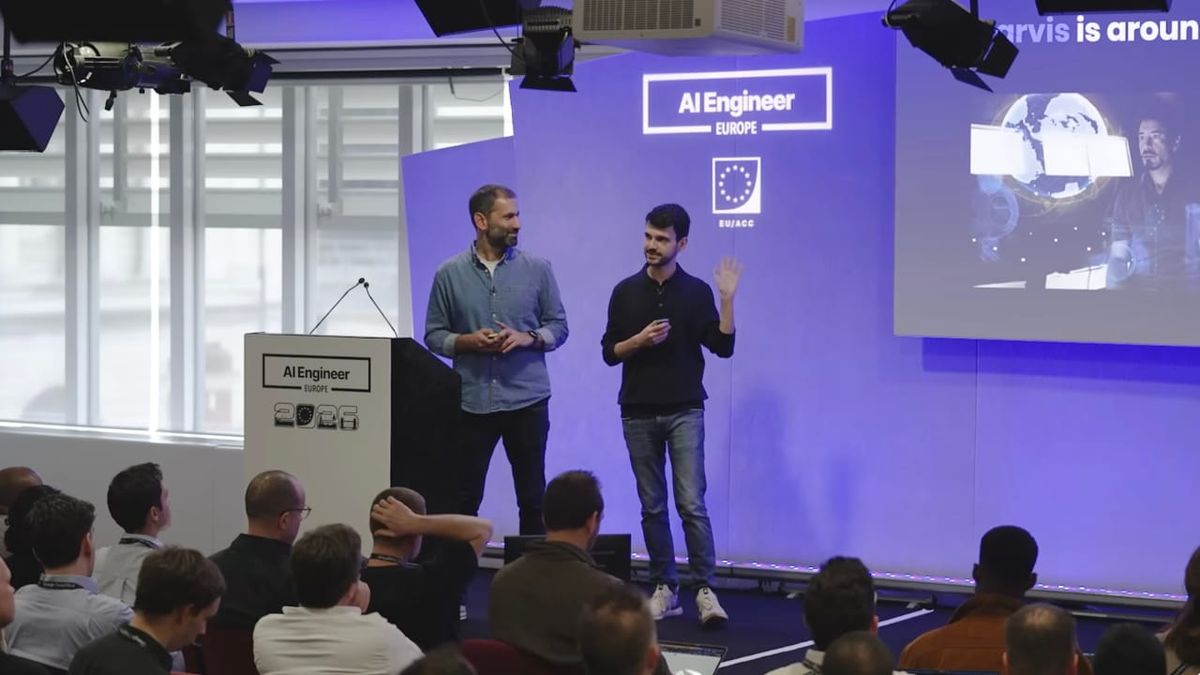
Around July last year, I discovered an open source project called MCP-UI — which provided a way to add web-based user interface components to AI agents. The project was brand new, having only been released in May 2025. In early August, I interviewed its two creators, Ido Salomon and Liad Yosef; and then I talked to some developers from Shopify, among the first companies to implement MCP-UI.
MCP-UI was one of the technologies that got me really interested in the intersection of web and AI, so when the project morphed into an official MCP project — now called MCP Apps — I continued to track it. Since going solo in February of this year and putting all my focus on agentic web, I've kept in touch with Yosef and Salomon — who are both now pursuing their own projects in this space.
To get up to speed with how MCP Apps is progressing, I spoke separately with both Salomon and Yosef. I've highlighted their key insights in this post.
The evolution from MCP-UI to MCP Apps
First, let's do a quick recap of what MCP Apps is and how it evolved from MCP-UI.
As Salomon and Yosef explained at the recent AI Engineer Europe conference (AIE Europe), after the first several months of MCP-UI, the pair teamed up with Anthropic and OpenAI to create MCP Apps, the "first official extension" of MCP. That project became officially available in January of this year.
In practice, MCP Apps allows an MCP server to return a UI resource — usually HTML — which the host renders inline in the conversation, with interactions passed back through the host rather than disappearing into a third-party app.
The goal from the start of MCP-UI has been to enable “UI over MCP.” There’s also a communication layer, so that the UI can interact with the host application. In MCP Apps, with Anthropic and OpenAI’s involvement, the goal remains the same but the scope has become much bigger.
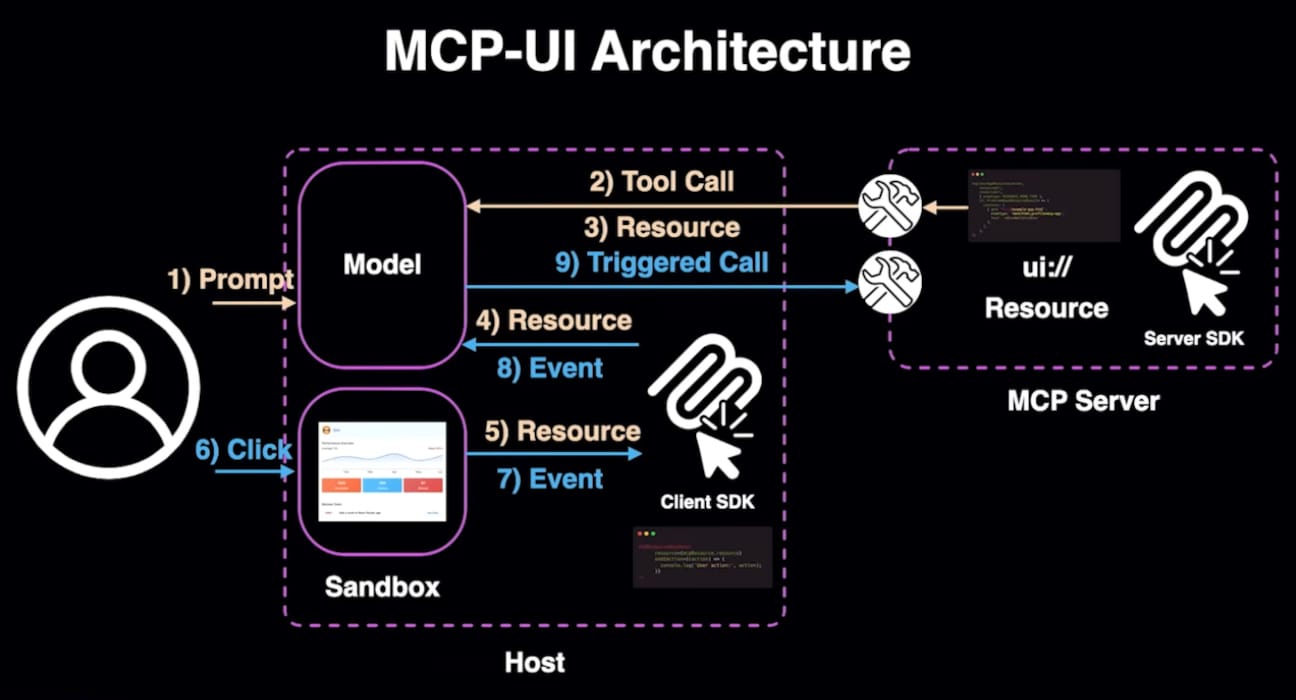
We can also think of MCP Apps as an attempt to standardize how applications behave when they are broken into agent-readable, agent-mediated chunks.
As Salomon put it at the AIE event, MCP Apps "isn’t just some tech… this isn’t some protocol. This is a new way to distribute applications."
Adoption is real, but discovery is still hard
When I spoke with Salomon recently, he emphasized how far the project has come since those early MCP-UI days.
“When we last talked it was still, I think only Goose supported it at the time,” he told me. “So yeah, I think pretty much everything changed… now pretty much every large host supports MCP Apps.”
He also pointed to growing adoption from external apps: “There’s hundreds of apps, like the biggest organizations… Instacart and Autodesk and I think even Walmart has an app. Canva too. So there’s definitely a lot of adoption going on.”
“There’s still a very large gap between these apps exist and they work… and end-users actually realizing how they can utilize it.”
- Ido Salomon, MCP Apps co-creator
But Salomon was careful to distinguish between technical adoption and user adoption. The capability may exist, and MCP Apps may be available inside chatbots, but that doesn’t mean users know when or how to invoke them.
“There’s still a very large gap,” he said, “between these apps exist and they work… and end-users actually realizing how they can utilize it.”
So that's one of the biggest issues facing MCP Apps today: discovery. In the previous web era, users discovered applications through search engines, app stores, social recommendations, and other attention-based mechanisms (buying a social media ad, for example). But in an agentic interface, discovery becomes much more ambiguous. If a user asks an assistant to book a trip, which travel app should appear? Booking.com? Expedia? Airbnb? TripAdvisor? A local provider? A paid partner?
“What happens when you have hundreds of apps doing the exact same thing?” Salomon asked. “Which one do you surface? Yeah, I think there’s a gap there.”
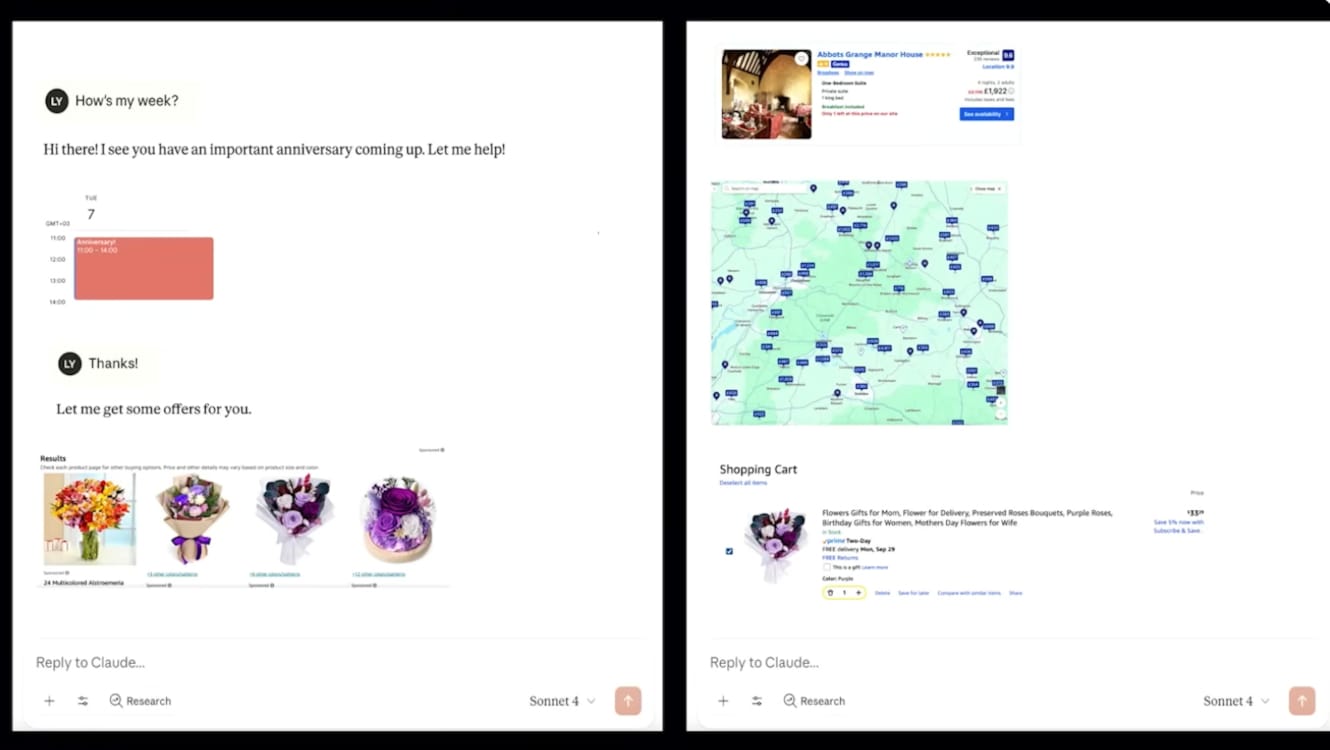
Yosef made a similar point when I spoke with him. He said there is “a big friction point of discovery” in the current model. If a user wants to use Booking.com inside ChatGPT, he noted, they may have to mention Booking explicitly — which is not necessarily how people expect to use a general-purpose assistant.
“It’s actually very difficult, very challenging, for those chats to do discovery of apps without it looking like ads, like promoted ads,” Yosef told me.
This is one of the most important market questions around MCP Apps. If apps inside AI systems do become a new distribution layer, then issues like discovery and ranking — and monetization! — will come to the fore.
Not the final form
Salomon and Yosef both moderate regular MCP Apps Workgroup meetings, as the extension spec and SDK continue to get hammered out.
Some of this work involves making sure MCP Apps fits into the wider ecosystem around MCP and web applications — at AIE, the pair referenced interoperability work they're doing with A2UI, AG-UI and WebMCP.
“MCP Apps [is] definitely not the final form of UI in AI.”
- Liad Yosef, MCP Apps co-creator
Also, Yosef told me that he does not see MCP Apps as the endpoint of the evolution of UI in AI systems.
“MCP Apps… while it’s an interesting domain or interesting space, it’s definitely not the final form of UI in AI,” he said.
In fact, Yosef is currently working on a stealth startup — already seed-funded by Sequoia Capital — that is aiming to build a platform for what he calls the "nearly headless web."
“MCP Apps is part of this nearly headless web,” he told me. “But the story is much bigger than that: it’s how agents interact with a product and how they authenticate it, how they pay it, how they integrate it, and eventually how they return the last mile of interaction to the user.”
I'll cover Yosef's new company once it launches, but the key point is that this is just the beginning. While MCP Apps aims to become one of the interface standards for the agentic web, the larger commercial opportunity sits around the surrounding layers: discovery, authentication, payments, integration, and the handoff back to the user.
From UI chunks to generative UI
One of the most compelling metaphors used in MCP Apps is that of a "UI chunk". A user of an AI system like ChatGPT or Claude will typically only need a small part of a host app or website, depending on the context in which they're using the AI system.
So if MCP Apps works as intended, developers will not only build websites, mobile apps, desktop apps, or SaaS dashboards. They will also build app fragments that run inside AI assistants. Those fragments will be interactive, contextual, and portable across different AI systems.
Salomon described the promise this way: “With MCP Apps, we already have standardization, and they [apps] all work the same. You can write your app once, and it will run everywhere.”
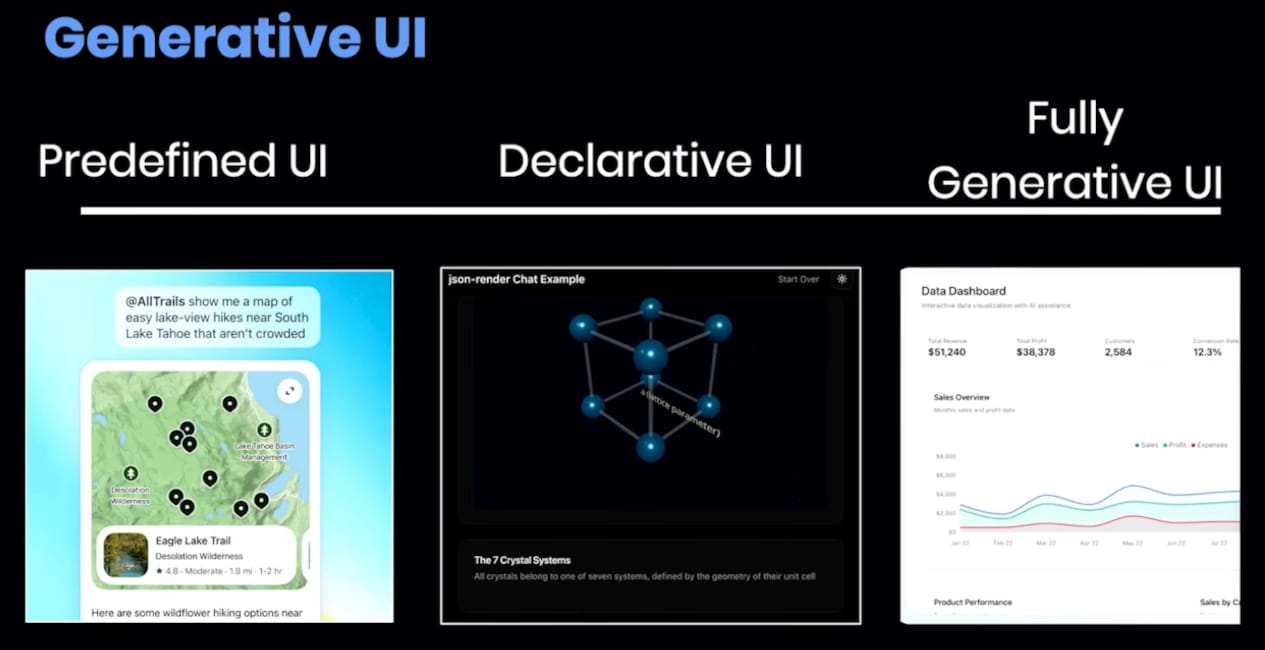
Not only that, but in the agentic web era we're starting to see the concept of "generative UI" bubble up — user interfaces generated on the fly for a particular query or task. Google highlighted this in its recent I/O conference, saying that generative UI was coming soon to its biggest product, search:
"Search can build the ideal response, in the right format for your question — completely on the fly. So you can get custom generative UI, including visual tools and simulations, tailored precisely to your needs."
Google added that its "generative UI capabilities will be available for everyone in Search this summer, free of charge."
Salomon is a little more cautious, but thinks the future "is probably at least partially generated [UI]." He points out that outside of Google, MCP Apps is already used for generative UI — for example, Claude's freeform Imagine feature, where the model generates apps on the fly inside the chat.
"...the next goal is to have a unified ‘umbrella standard’ across methods of UI generation."
- Yosef
The direction seems to be that MCP Apps can provide one standardized container for UI inside AI hosts — whether that UI is predefined by the app, declared in a more structured format, or partially generated by the host.
As Yosef put it, "the original purpose of MCP Apps was to create a unified UI standard across hosts (and it succeeded in that) — now the next goal is to have a unified ‘umbrella standard’ across methods of UI generation."
The future of apps
It's pretty clear that apps in the agentic web will become smaller, more componentized, more contextual, and more dependent on AI systems as the organizing layer.
That's why I think MCP Apps is one of the most important projects to watch in the agentic web. What began as a way to pass UI over MCP (MCP-UI) is now becoming a candidate application layer (MCP Apps) for AI assistants and agents.
This also ties back to my most recent market signals post: for companies, the strategic question is no longer just whether you have a website or an API, but whether your product can show up as a useful, trusted interface inside an agent’s workflow.
Enjoyed this post? Sign up for more agentic web interviews and insights.
Comments ()