
Google's agentic web stack takes shape — but publisher economics remain unresolved
At I/O, Google pushed Chrome, Search and dev tools toward an agentic web. But the harder question is economic: who gets paid when agents use the web? Index by Parallel offers one solution.
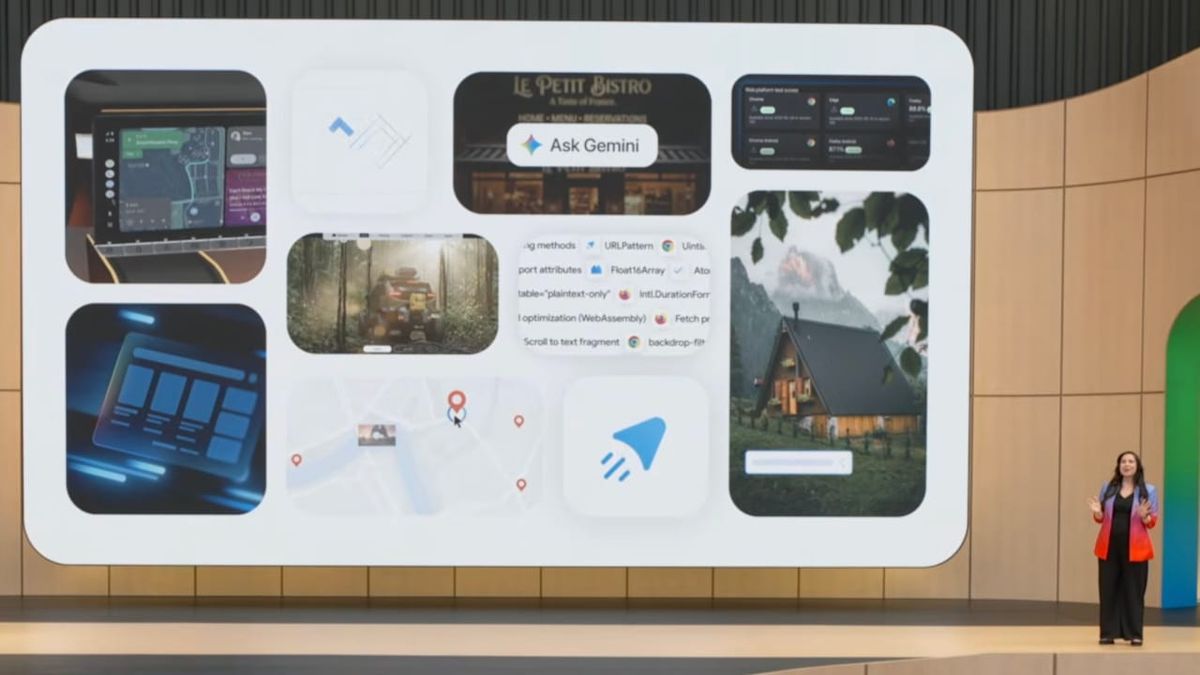
The past week in the emerging agentic web was dominated by Google's annual developer conference, I/O, which was all about this trend. As one Google executive said during the keynotes, "we've entered a new agentic era across Google."
Unfortunately, Google didn't address economic incentives for publishers at I/O. But we did get an interesting development in that domain from another company, which I'll discuss in this post.
So let's get to it. Here are the key market signals I've identified...
Market Signals
📡 Google Chrome's power tools for the agentic web ⬆️
At I/O, Google laid out an extensive — although not always coherent — vision for making the web more agent-ready. The most grounded signals came from the Chrome team, which laid out a vision for "powering the agentic web" in a series of announcements.
The most signficant announcement was "Modern Web Guidance," a set of skills you can add to your AI coding agents in order to get back accessible, performant and browser-compatible code. It's being positioned as a complementary tool to Baseline, an industry standard index of cross-browser features:
"It integrates directly with Baseline, letting you focus on what you want to build while your tools automatically figure out the right features and fallbacks to use within your chosen Baseline target."
The Chrome team also announced the graduation of WebMCP to an "origin trial" in Chrome 149. WebMCP was positioned at I/O as "a proposed open web standard that lets you expose structured tools like JavaScript functions and HTML forms to browser-based agents." WebMCP support is also among the new tests being added to Chrome's Lighthouse audit tool, in its new "agentic browsing" section (available from Chrome 150).
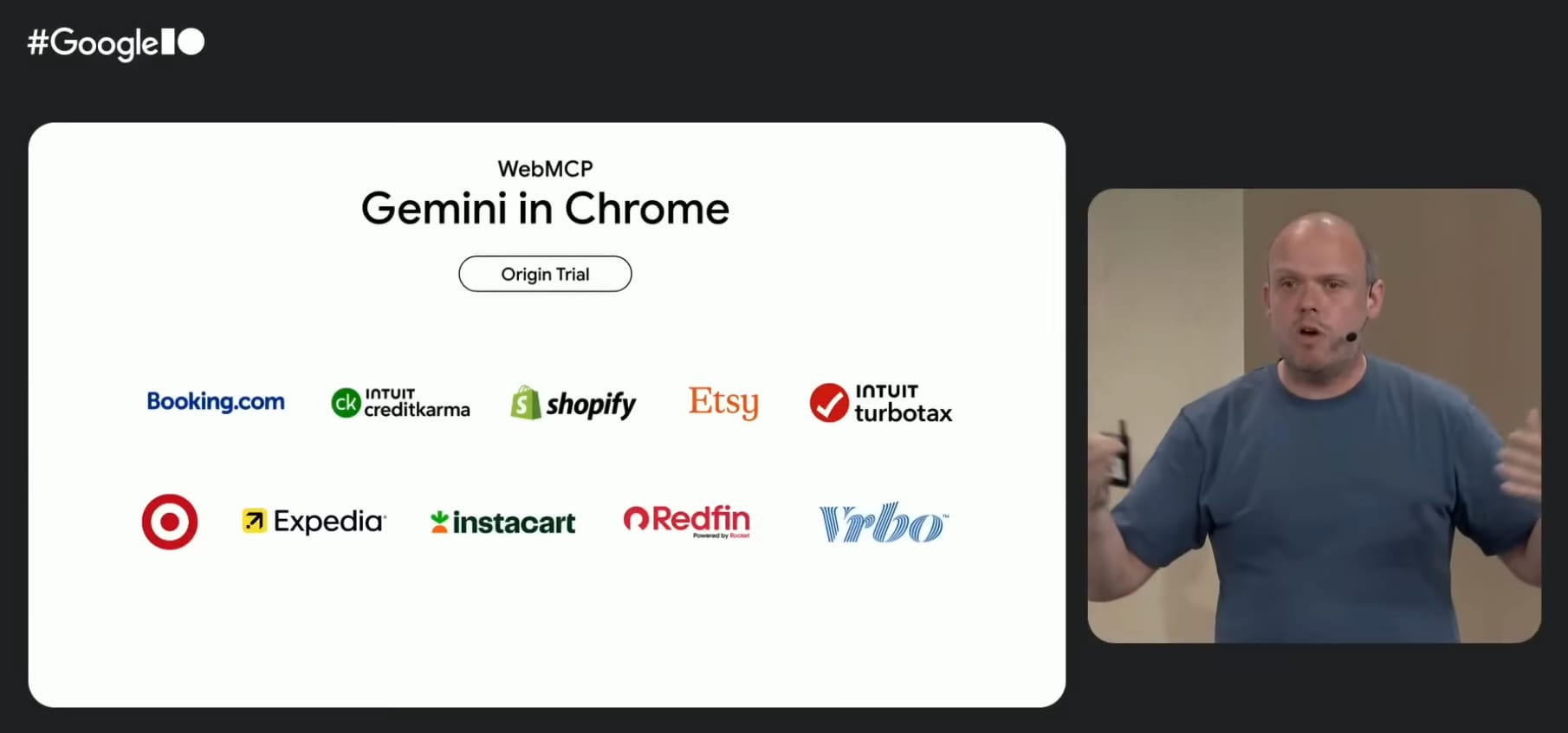
While Google was careful to note that WebMCP is still experimental and not yet widely supported, its promotion at I/O indicates that agent-native protocols for web development will soon be commonplace. It kind of reminds me of the early years of RSS, when bigcos like Microsoft and Yahoo were starting to integrate it into their products.
Other notable Chrome announcements at I/O included Chrome DevTools for agents and a new HTML-in-Canvas API. While the latter is not directly agentic, it will lead to more "app-like" functionality in the browser — and because it has HTML semantics, it should be easier for agents to 'read'.
📡 Google AI search: big plans, but vague on details 🤷
Outside of the Chrome team, the signals from I/O were rather mixed.
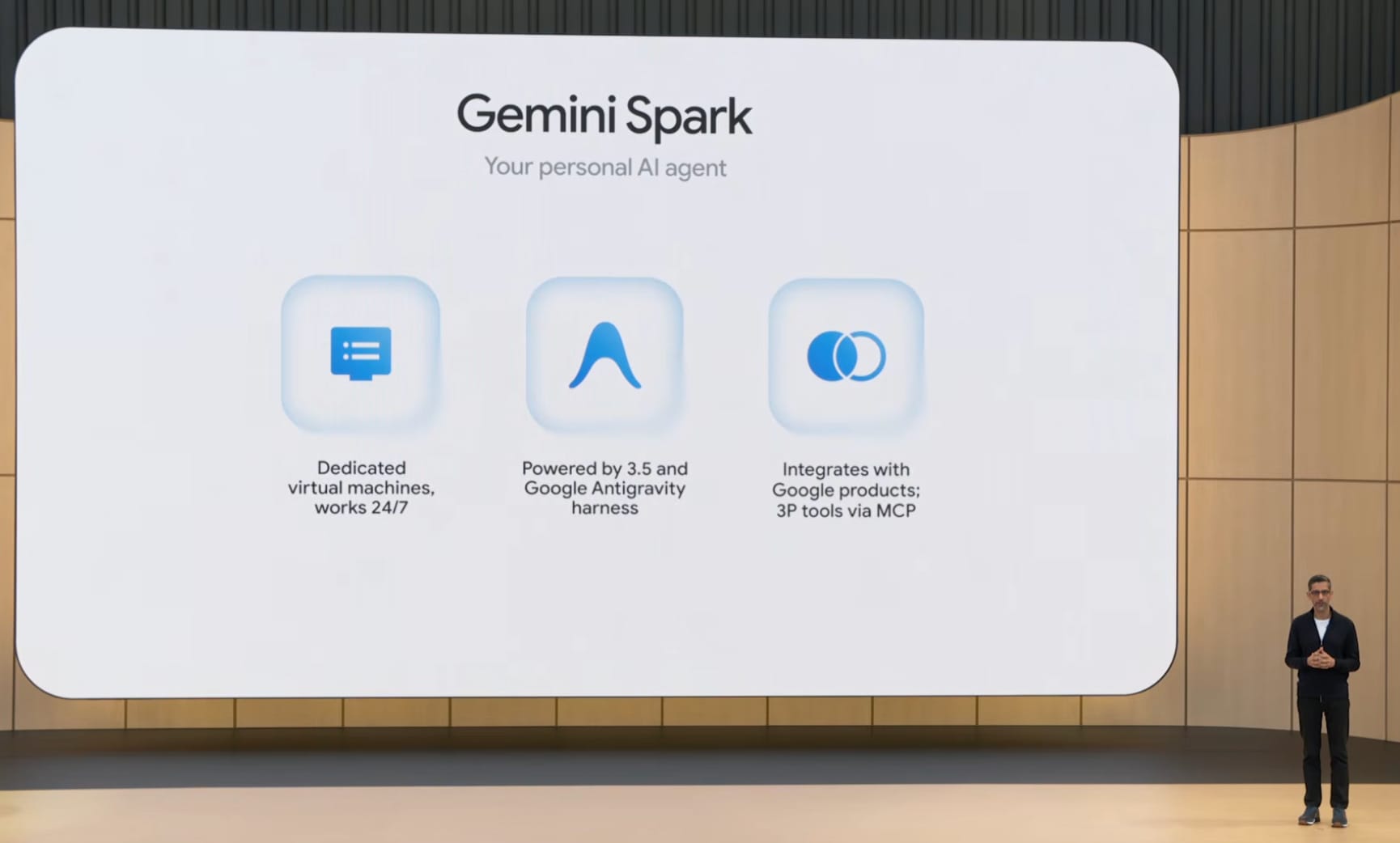
A new product called "Gemini Spark" was announced; it's being labeled as "your 24/7 personal AI agent." The idea is that it will have access to all your main Google productivity tools — such as Gmail and Docs — and can then use that personal knowledge store to assist you in your daily workflow. At I/O, it was noted that Gemini Spark will "operate directly within Chrome, acting as your agentic browser across the web."
However, specific details about Gemini Spark were thin on the ground and it's currently in a limited rollout to certain enterprise customers. It's also not entirely clear whether users will want such a personally invasive AI tool.
I also thought the I/O announcements around AI search and Antigravity (Google's "agent-first development platform") were not 100% convincing. "We're entering the era of search agents," Google CEO Sundar Pichai said during the main keynote. While having agents run background searches for you does sound useful — conceptually, it's not all that different from Google Alerts — talk of "custom experiences" for search via AI coding agents is possibly an over-reach at this stage.
The idea itself sounds intriguing: build an on-demand "mini app" for the user instead of giving them an answer or link. But to achieve this functionality, a Google executive noted that "search invokes an agentic coding harness powered by Antigravity." If Google does manage to get the UX right, it could be amazing for users (albeit yet another reason for people to not click through to external websites). But this could also become the 2026 version of Yahoo Pipes — an RSS tool from 2007 that aimed to help people create "data mashups," but ended up being used by only a tiny percentage of Yahoo's user base.
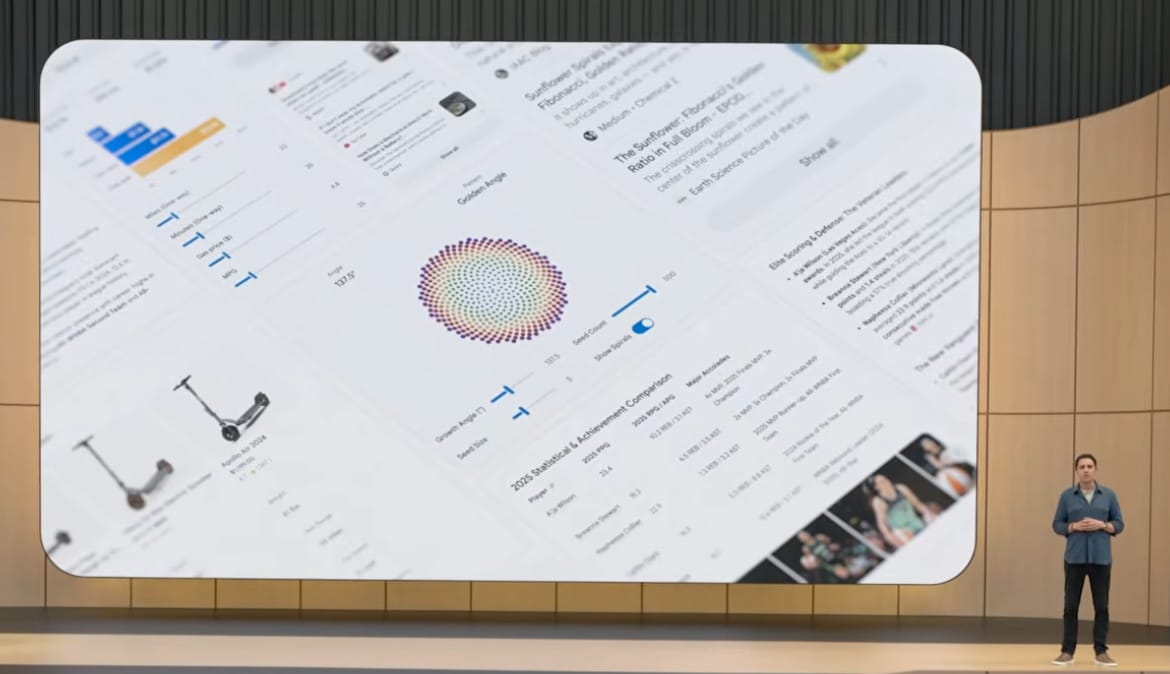
A lingering issue is how an even more powerful AI search will impact the wider web ecosystem — particularly publishers, who are already struggling. Google didn't address this, but perhaps the next market signal will help...
📡 Economic incentives ⬆️ with Index by Parallel
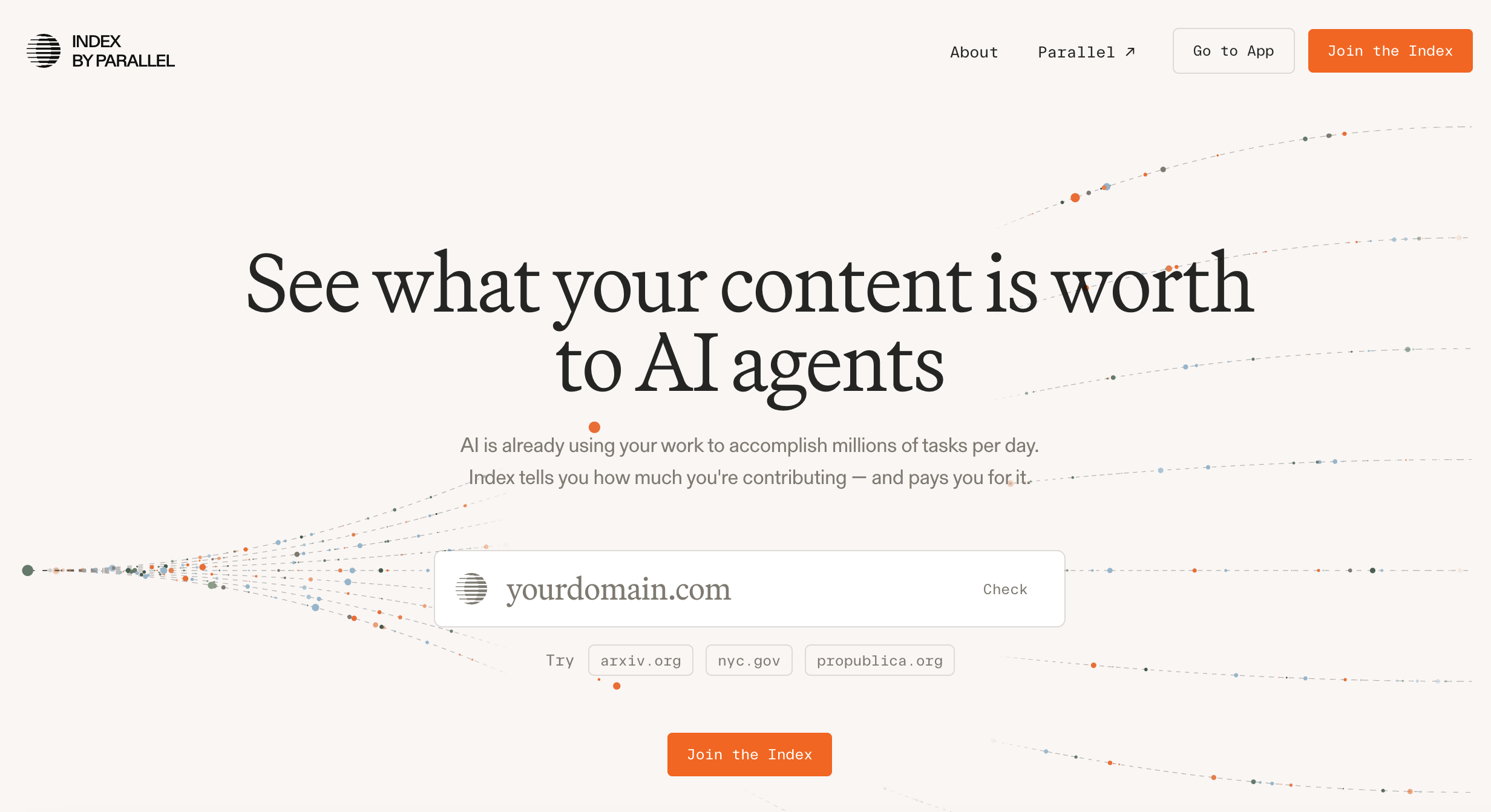
Index is a new micropayments system from Parallel Web Systems, a VC-funded agentic web infrastructure company that I briefly profiled last week. Index aims to give web publishers an Adsense-like system for earning money from agents that use their content. And like Adsense, the underlying algorithm for deciding how much to pay you is quite opaque:
"Compensation is calculated by estimating each source's Shapley value, its marginal contribution to the work an agent performs at the moment of inference. Content that's uniquely valuable, hard to replace, or used in high-value agent work earns more."
The catch is that agents need to opt into this. According to a Fortune writeup, Index "will first apply to AI agents using Parallel’s own tools, though the company says it wants Index to eventually work with agents built outside Parallel too." Parallel claims it "already serves a large and rapidly growing base of agents, with more than 100,000 developers and frontier AI companies like Harvey, Attio, Notion, Modal, Rogo, and Opendoor relying on its infrastructure to power millions of AI agents each day." That's impressive, but there is an ocean of other agents out there — and their owners will need to be convinced to join Index.
Other AI infrastructure players are also looking into a revenue model for publishers. Most notably, Cloudflare's Pay Per Crawl is currently in a closed beta — as the name suggests, it charges agents a small fee to crawl a publisher's site. Parallel's vision is wider and more nuanced; and it doesn't appear to put up a paywall for agents, as Cloudflare is doing.
I'd love to see Google try something in this area. We got no inkling of that at I/O, but the company did announce more partners for its SynthID product (which enables content to be watermarked) and an expansion of its support for C2PA (an independent content credentials system) to search and Chrome. Now, these systems currently only show if a piece of content used AI. But what if SynthID and C2PA were expanded to also show who owns a piece of content. That would open up the opportunity for a Google version of Adsense for this era. As I say, none of that was even hinted at during I/O — but perhaps something to keep an eye out for in next year's conference.
Watchlist
👀 WorkOS and Auth.md
A company called WorkOS has just launched auth.md, which it calls "an open protocol for agents to register for services on the web." It's basically a Markdown file that tells agents how to register for something on behalf of a user. Early partners include Cloudflare, Firecrawl and Monday.com.
However, note there was an issue raised in the project's GitHub about SSO and multiregion support, as well as potential duplication with a few proposed OAuth 2.0 standards.
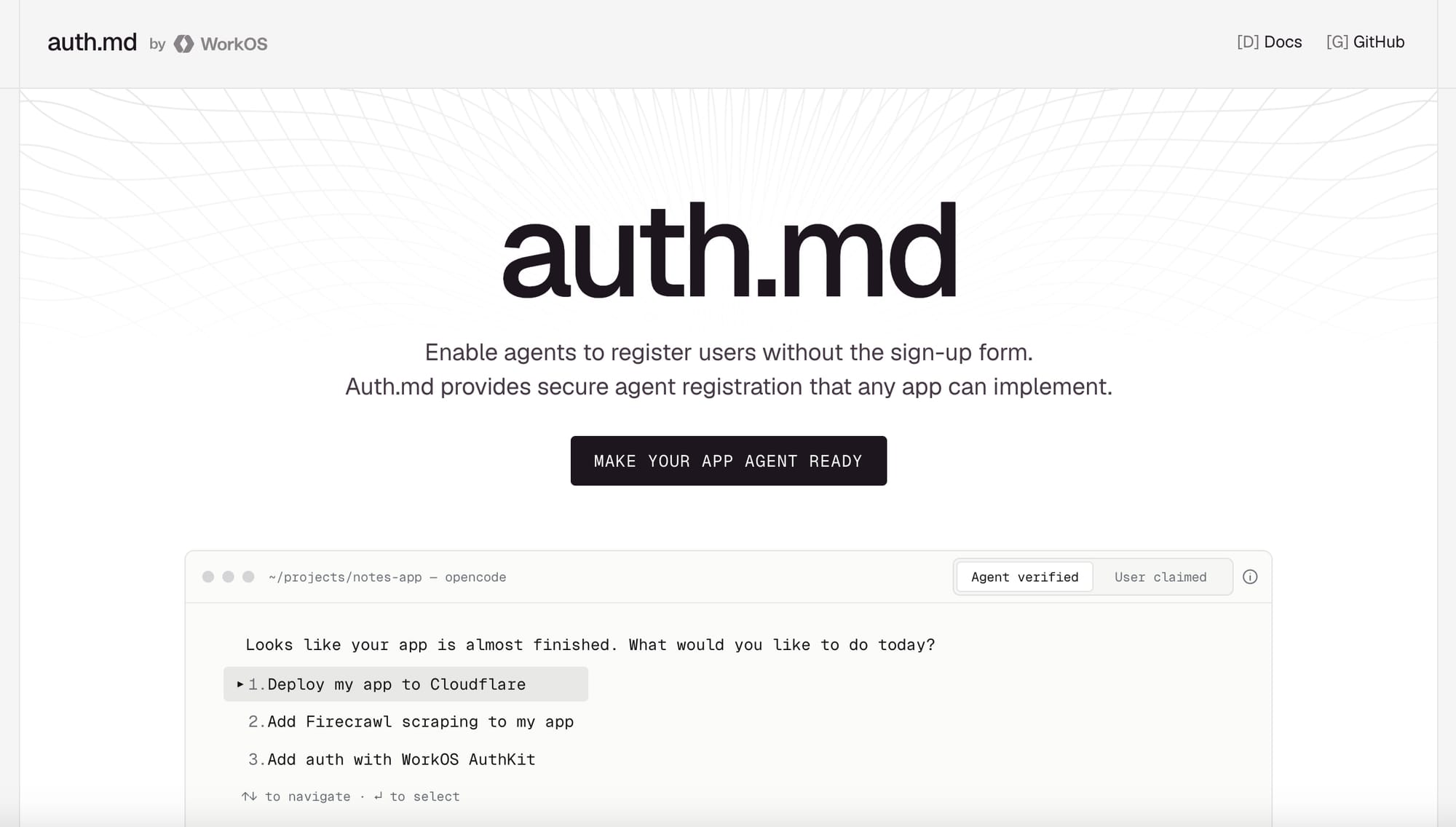
So it remains to be seen what traction auth.md gets. Regardless, it's good to see work happening on agent registrations — whether on the OAuth side or in other projects.
Thanks for reading Agentic Web News — my independent analysis of the companies, standards and ideas shaping the next phase of the web. Alongside weekly market signals, I’ll be publishing interviews with the early builders defining this space.
If this issue helped clarify where the agentic web is heading, please forward it to someone who should be tracking this trend.
To receive future editions, subscribe by email. It's currently free, but you can also become a founding supporter of AWN, to help it become financially viable.
I also advise companies on agentic web strategy, Agent Experience, AI visibility, and agent-facing product strategy. Learn more at ricmac.org.

Comments ()