
How RunSignup is building AI agents into every part of its platform
RunSignup, a web platform for race organizers, is deploying AI chatbots and building agentic infrastructure across its product. Founder Bob Bickel explains how AI is reshaping SaaS.

We're still so early in the agentic web era, so I was surprised when I came across a mainstream web platform already putting AI agents into production.
RunSignup is a web technology company that specializes in events management for runners. It describes itself as "the largest registration platform for endurance events," with about 35,000 events using it. While its user base is not always technical, RunSignup has already deployed AI chatbots across customer websites and is now building infrastructure to integrate agentic functionality throughout its product.
I spoke with RunSignup's founder and CEO, Bob Bickel, who describes himself on the site as "a race director and runner frustrated by existing online registration solutions." But he also has a long history in the software industry, dating back to the application server market in the early 1990s. And now, as I discovered, Bickel is keenly exploring agentic technology.

What AI features does RunSignup have?
RunSignup has been around since 2010; and if you look at the site today, it's similar in look n' feel to many niche, yet enterprise-grade, SaaS platforms. However, if you check out its AI section, you'll see that RunSignup has built a variety of AI features: an AI chatbot for support, a vibe coding API (using OpenAPI and OAuth2), an AI assistant ("built directly into the race setup and website-building tools"), an MCP server with about 40 tools (although this hasn't been publicly released yet), and more.
But this is only the beginning. Just last week, RunSignup introduced the first stage of its agentic AI rollout: a new "AI infrastructure" platform for agents. It's based around two primary agents — a Public Agent (on race pages) and a Dashboard Agent (inside the race director dashboard).
“Everywhere in our product, in every screen, there will be an AI agent there,” Bickel told me.
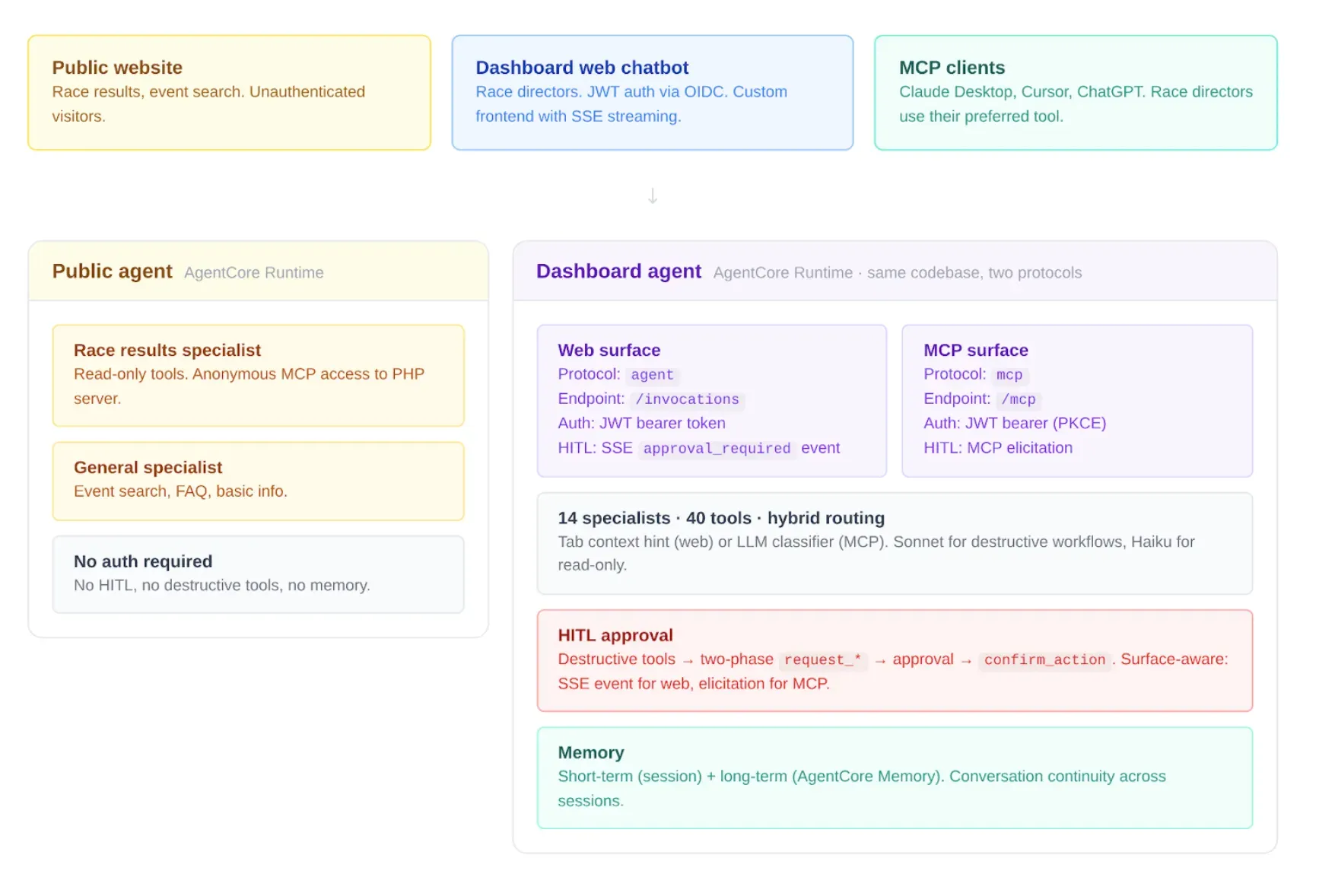
Bickel explained that the system was built using Amazon Bedrock AgentCore, an AWS platform for AI agents.
"Basically what we need to do is make sure that we've got this really secure, scalable layer that allows all of our development team to build AI directly into any of the things that we're building as a product," he said.
As for how these agents will be exposed to users, Bickel said it will either be via a chatbot on a RunSignup customer website, or via MCP through external chatbots like Claude and ChatGPT.
Move fast, but safely
RunSignup is wary of the security implications of running agents — especially since its customers aren't necessarily tech-savvy — so it has adopted the 'human in the loop' design pattern. In the dashboard agent, for example, Bickel said that "if you're changing data or deleting data or something like that, it'll have built-in human in the loop mechanism."
In fact, in all of its AI adoption, the RunSignup team abides by a principle it calls "aggressive patience." Move fast, but safely — a much better approach to new technology than the 'move fast and break things' culture of Web 2.0!
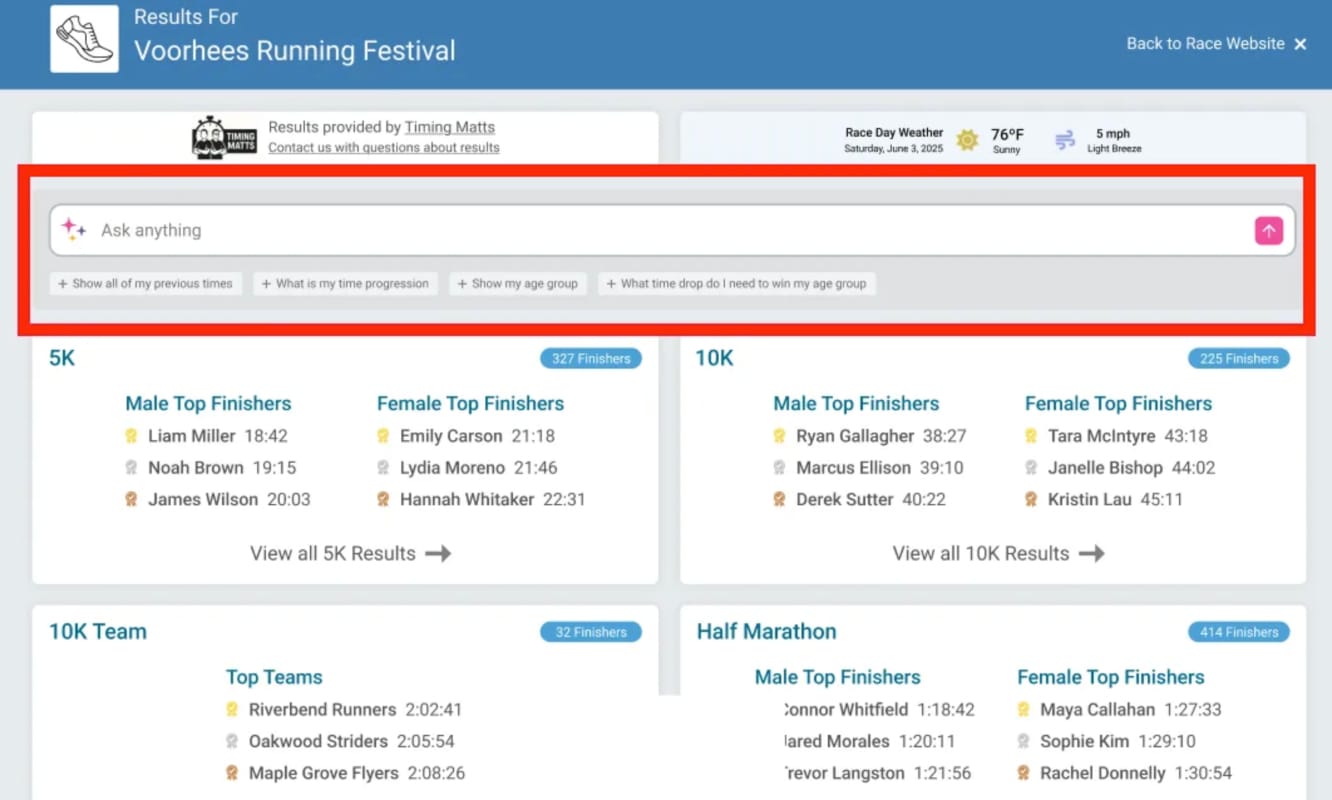
As an illustration of "aggressive patience" in practice, Bickel points to their vibe coding API and the boundaries they've placed around it.
"So we have about 40 different MCP tools internally that we've not released to customers yet," he said. "And the reason is, what we're seeing is that these vibe-coded applications are not all done very well. And so, as we watch our API usage stats, we see a combination of incorrect usage and non-optimal usage of these tools. And the other thing that we see is malicious actors, a marked increase in malicious actors. We get a lot more DDoS attacks now, and things like that, because everybody can vibe code."
New workflows for agents (and their humans)
From an end user perspective, Bickel noted that workflows will become much more conversational once agents are fully integrated into its web platform. He gives an example of a race director organizing something using agents.
"So if you're a race director, you have a dashboard control and set all your different options, and it has like a hundred menu items in it. What you’ll start to see is that some of these dashboard pages will now have this AI agent — either a little text box that you can chat in, or a circular chat widget that you can click on to perform the task."
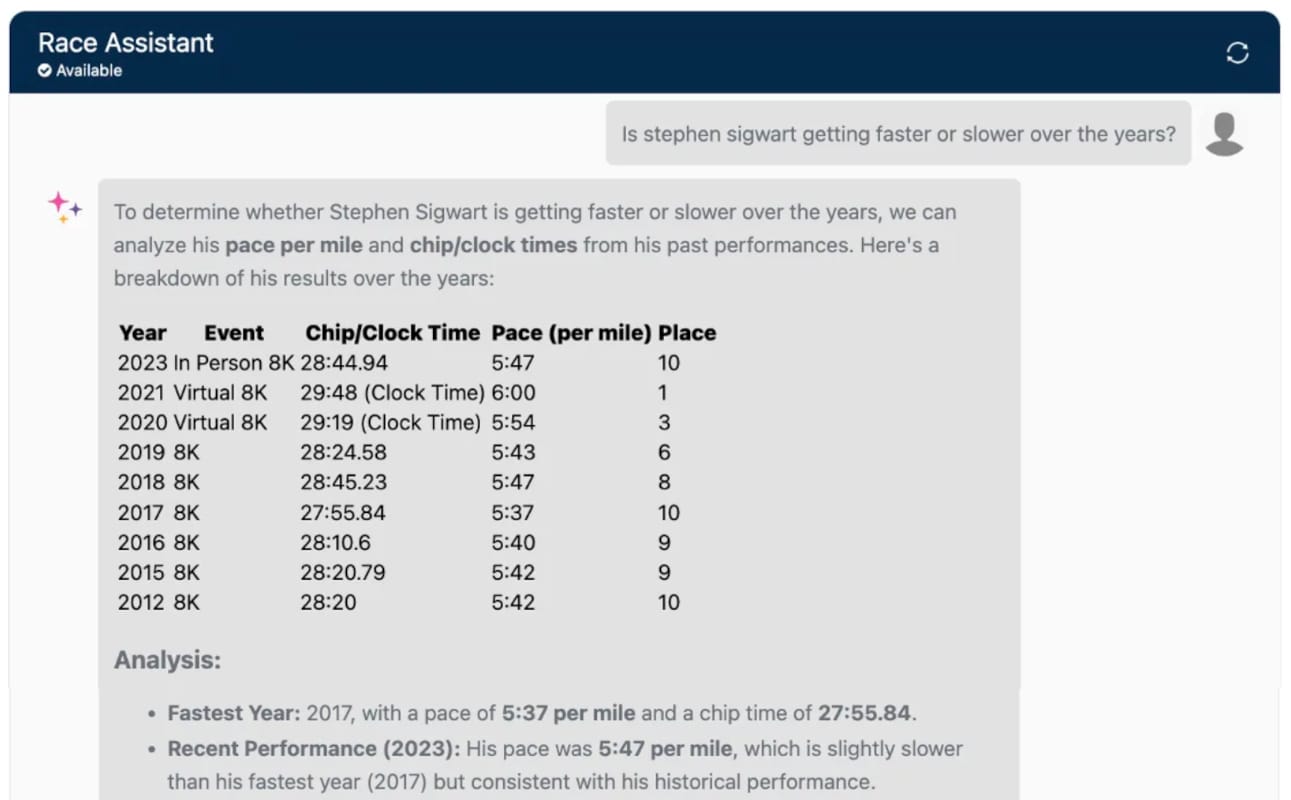
There's been speculation in the industry that agents will eventually take over everything and so there will be no need for websites at all. When I put this to Bickel, he scoffed that such a future is "a long way off" and that perhaps some people in our industry "drink the Kool-Aid a little bit too much."
On the other hand, he looks at products like Claude's browser extension — which can automate tasks and take actions on a user's behalf — and the emergence of headless browsers, and thinks "a lot of agents are going to make use of websites to do their work." So Bickel does see the use of autonomous agents increasing over time.
MCP tools and the discovery issue
One of the trends I've been exploring on this site (and on my consulting website) is the emergence of protocols and standards that give agents more capabilities. For instance, WebMCP — which Google is about to deploy as a trial in the next version of Chrome — allows website operators to define tools that agents can access and use. I asked Bickel if he's exploring this type of technology?
"So that's basically what we're doing with these MCP tools," he replied. "Every action that we're enabling within our own ecosystem right now is done with a generic MCP interface that will interface with all of these different MCP agent orchestrators, LLM chats, and things like that out in the world."
He mentioned that the "maturation of everything" is holding them back a bit. That's understandable, because (for example) WebMCP is not yet ready for mainstream deployment. And, again, he noted that trusting third parties with their customers' data is also something they're extra-careful about.
He added that there's a discovery issue with MCP tools that hasn't been fully solved.
"So right now, what you have to do is if you're in ChatGPT or if you're in Claude, you have to go and add the tool to make it discoverable. So it's a very manual process. Our expectation would be that these become self-discoverable over time. So if I'm sitting inside of Google, I'll be able to sign up for a race inside of Google somehow, some way — without having to install MCPs and all that kind of stuff."
Conclusion
I'm pleased RunSignup is the first product profile and interview I'm running in Agentic Web News, because it's a great example of a mainstream web platform adopting AI — indeed, I'd argue it's at the cutting edge of what can be deployed to a non-technical user base at this time.
It's a reminder that although we in the tech industry are prone to have extreme views on the subject of AI (you either love it or hate it), there are already practical applications for agentic web functionality out in the real world.
Comments ()