
Browsers in agents, WebMCP momentum, and AI engineering lessons
Key trends from the AI Engineer World's Fair, browsers moving inside agents, and fresh WebMCP momentum across commerce and web development.

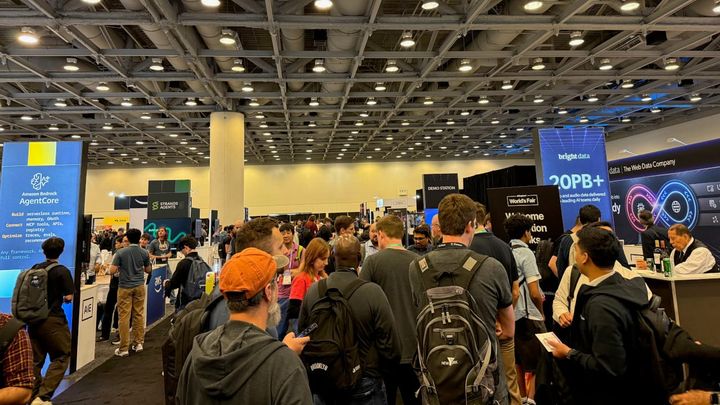
This week I published 5 Trends That Defined AI Engineering at World’s Fair 2026 on Latent Space. As previously noted, I attended the AI Engineer World's Fair in San Francisco earlier this month — where I learned that the state of the art in AI engineering looks a lot like the state of the art in software engineering. As I put it in my intro:
"The engineering practices that have developed around AI over the past three years — building coding agents, designing harnesses, managing context, evaluating model outputs, and orchestrating increasingly autonomous systems — are becoming part of mainstream software development."
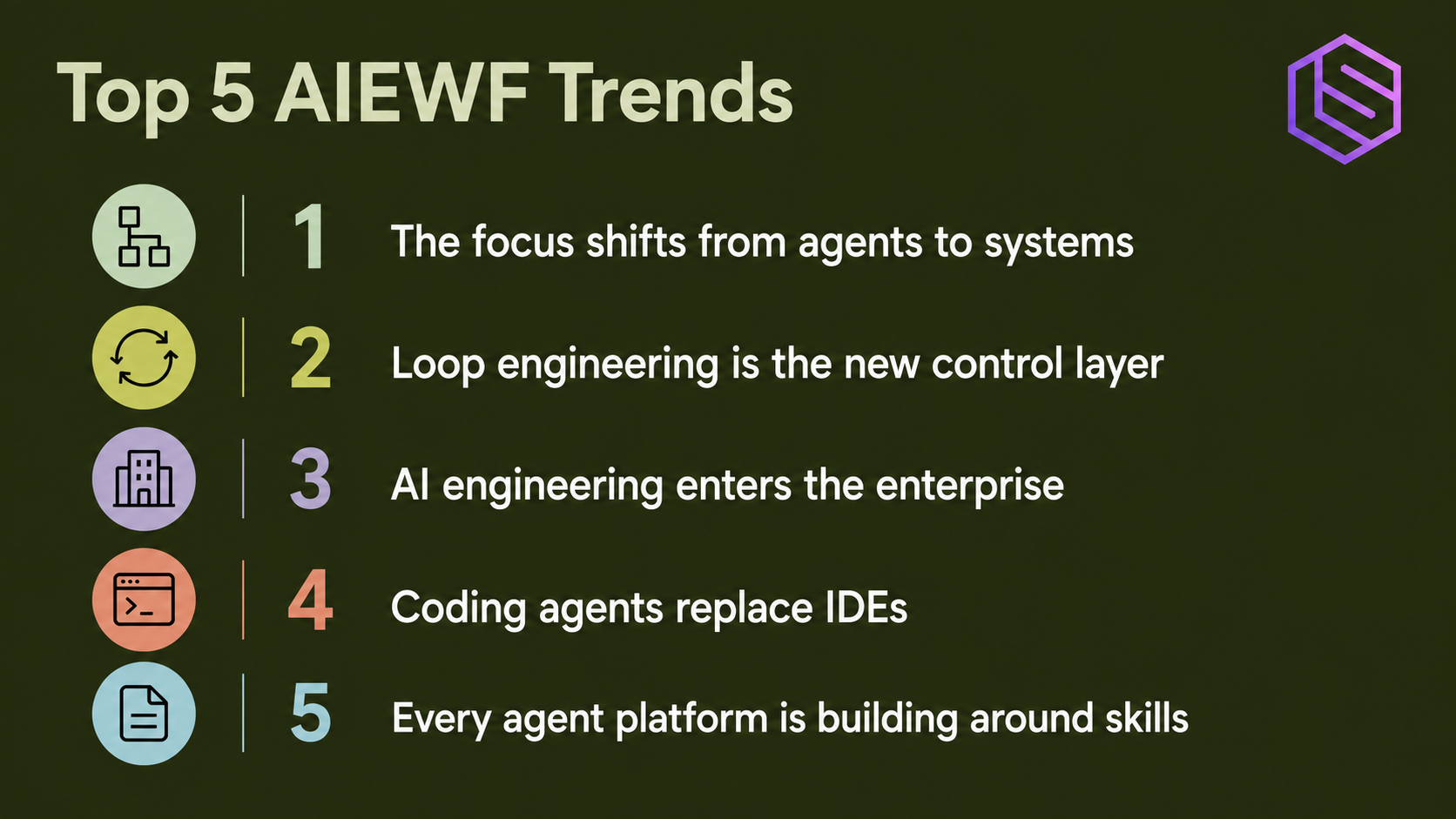
Here's a graphical summary of the top 5 trends, but I encourage you to read the whole post if you want to keep up-to-date with AI development trends.
Agentic Web rising
I've noticed in recent weeks that the agentic web as a concept is beginning to increase in popularity, even if it's still relatively niche compared to agentic coding and LLMs. The AI Radar, a tracker for AI use cases created by Janna Lipenkova, now has a definition for agentic web:
"The Agentic Web is an evolving internet phase where AI agents autonomously discover, interpret, and act on websites, transforming traditional human-centric web interactions into machine-mediated, capability-driven engagements."
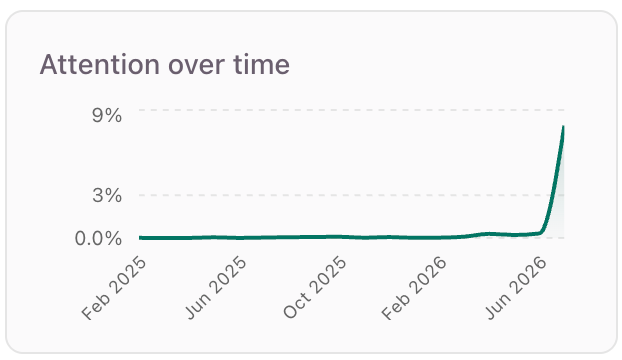
There's also a graph indicating a July spike in attention:
Another new directory service is the Ora directory, from Liad Yosef's new company Ora (Yosef is a co-creator of MCP Apps). The Ora directory is being promoted as the "agentic index of the web" and is built on two emerging open specifications: AI Catalog and Agentic Resource Discovery (ARD).
Ora is now the official implementation of the two pillars of the agentic web: ARD and ai-catalog.
— ora (@oradotai) July 8, 2026
Introducing https://t.co/wGLMeCHuIr.
Expose agentic resources from any domain using the ai-catalog standard.
Search any agentic resource on the web with Agentic Resource Discovery. pic.twitter.com/wqGVkMEKBv
If you're a business wondering how to get started on the agentic web, check out this post by Google's André Bandarra:
"The most pragmatic approach is to prioritize foundational agent-readiness as your baseline. From there, you can layer on bespoke on-page agent capabilities only where the return on investment, in terms of user journey completion or product value, warrants the significant development and maintenance effort."
Yet another sign I spotted this week of increased visibility for agentic web: internet legend Vint Cerf, who recently retired from Google, is now advising Innovation Labs, which TechCrunch described as "an organization trying to create the open architecture for AI agents to identify themselves."
I'd interviewed Innovation Labs CEO Allie Kline in early June, in an AWN post entitled Who owns that AI agent? DNSid proposes an answer. It's great to see Cerf lending his considerable expertise to this project, which makes me think it now has a good chance of gaining traction.
Browsers in agents
In a post entitled The Agentic Web Summer, agentic commerce startup Nekuda (which I've also interviewed for AWN) makes the case that after OpenAI and Anthropic both put browsers inside their agents, it "makes the website itself part of the agent stack."
Nekuda first summarized the news:
"OpenAI is shutting down Atlas, but it is not walking away from the browser. The same capability is moving inside ChatGPT and Codex, and Anthropic went the same way in the same week with a built-in browser inside Claude Code on desktop."
...then posited:
"Most of the web was built for humans and will not be rebuilt for agents anytime soon, so an assistant that wants to do general-purpose work, for consumers or for enterprises, needs the tool humans use to reach all of it."
Here's the official Anthropic announcement:
Claude Code on desktop now has an in-app browser.
— ClaudeDevs (@ClaudeDevs) July 10, 2026
Claude can pull up docs, designs, or any other site. It can read, click through, and interact the same way it does with your local dev servers.
It's sandboxed and configurable: you choose whether sessions persist. pic.twitter.com/Jbc21OP0vJ
Nekuda is building on WebMCP, a browser protocol that is currently behind browser flags, so it rightly pointed out "the cleaner path" this protocol provides.
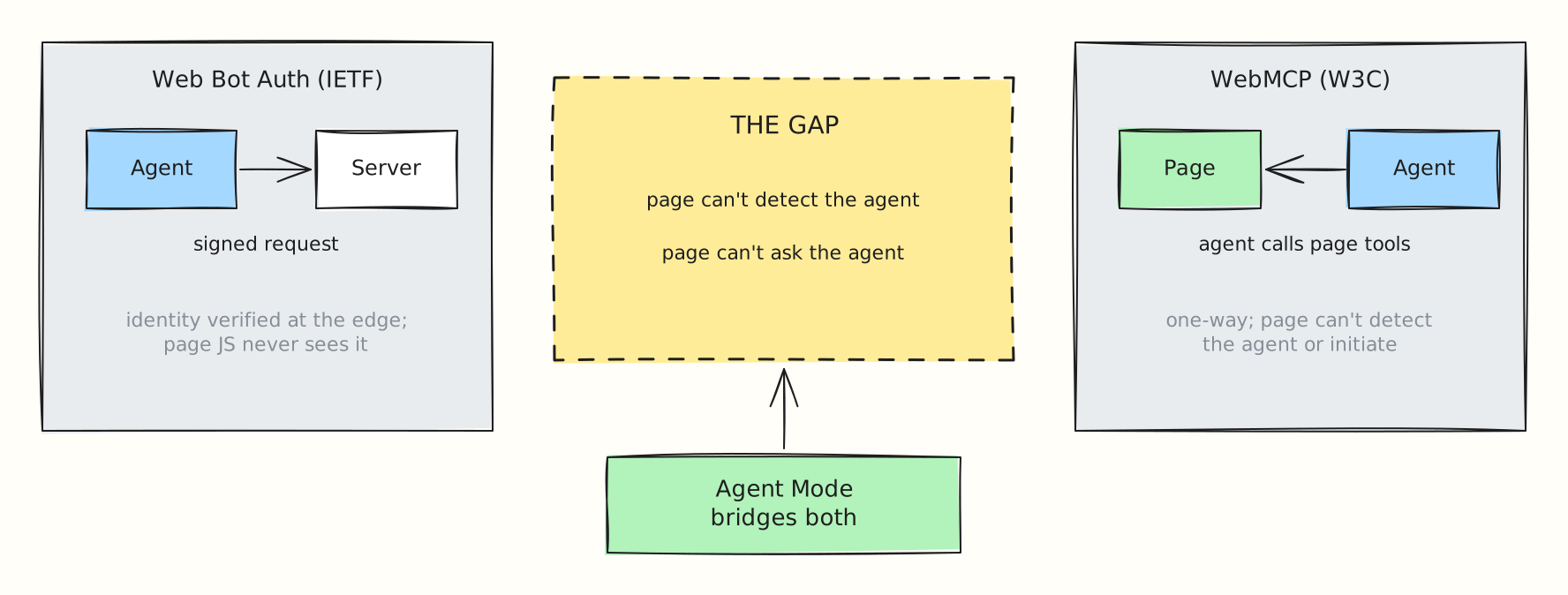
Related, Kieran Klaassen from Every has suggested a straw man proposal called Agent Mode, "so in-agent browsers can tell websites who they are, websites can talk back, and you can hand your agent work without leaving the page." Klaassen argues: "Web Bot Auth stops at the server; WebMCP is one-way. Between them sits the gap Agent Mode bridges."
Speaking of agents and websites talking with each other, I want to recommend the new blog of Google's Kasper Kulikowski. It's definitely worth adding to your RSS Reader; this week he wrote up some of his practical experiments using WebMCP and A2A.
Agentic commerce news
A couple of significant agentic commerce news items this week: DoorDash now speaks directly to agents, and Shopify has begun implementing WebMCP.
Today we're opening up the DoorDash CLI in limited beta.
— Andy Fang (@andyfang) July 15, 2026
`dd-cli` lets you order DoorDash directly from your agent: search stores, find the best deals, check out, and more.
Early access for US/Canadian macOS developers by waitlist. Excited to see what folks build! pic.twitter.com/rSFhjJnvjJ
Nekuda on the Shopify implementation of WebMCP:
"Shopify rolled out WebMCP to the storefronts it renders. This was done silently, without any public announcement to date. A small script now ships on Shopify-managed stores and registers callable tools on every page. Agents can search the catalog, pull product details, manage the cart, start checkout, and open order history."
Similar to how early dot-com companies like Amazon and eBay pushed the web forward with commerce plays in the 1990s, online shopping companies like DoorDash and Shopify are doing the same for the agentic web.
Web development news
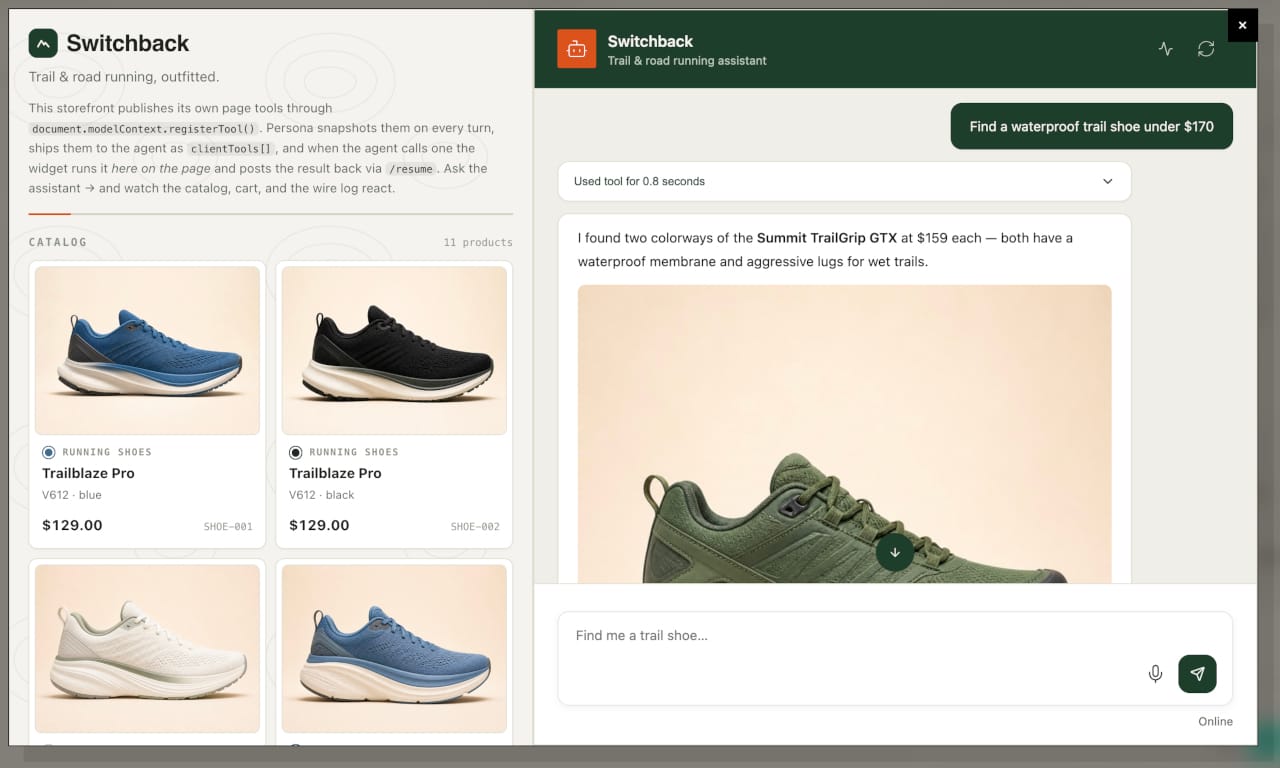
Persona is a brand new JavaScript library that "helps you create agentic front-end experiences for the web, in pure JS." It's positioned as "lightweight, extensible, and WebMCP-native."
The library comes from a company called Runtype, a "AI-native product platform." Co-founder Nathan Booker commented on Product Hunt:
"Most AI chat libraries assume you're starting from scratch on React. Persona is built for the rest of the internet: existing sites, mixed frontend stacks, proprietary CMSes, and teams that want a modern AI experience without rebuilding in React."
Google Web AI lead Jason Mayes was impressed:
"It’s a stellar contribution to the community, helping developers build smooth, robust, and local human in the loop AI copilots without rewriting their entire frontend stack!"
I love that Persona.js uses Vanilla JS, and also the support for WebMCP is another strong signal for websites as capabilities.
Finally, while not web dev per se, I thought this news from Parallel was an interesting sign that the agentic web is infiltrating the enterprise now:
Today we're announcing our product integration with @googlecloud for agentic web search on the Gemini Enterprise Agent Platform. pic.twitter.com/F0lovOlGpU
— Parallel Web Systems (@p0) July 16, 2026
Let's get agentic
So, another busy week in the ongoing build-out of the agentic web! I'll continue to do weekly wrapups of developments here. Also keep an eye on Latent Space, because I'll be writing many more AI engineering stories on LS going forward. More news on that front soon.

Comments ()